English
 Español
 tiếng việt
 русский
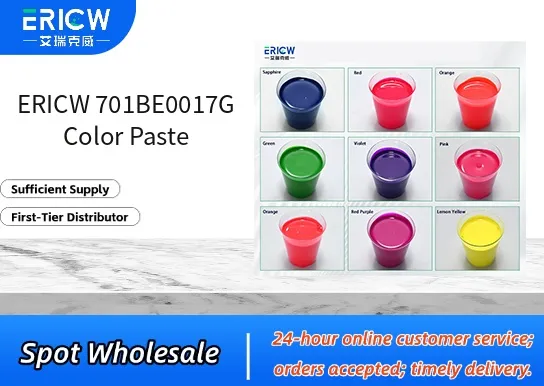
High chroma and excellent color consistency across batches.
Optimized for compatibility with water-based acrylic, polyurethane, and alkyd resin systems.
Low volatile organic compound (VOC) content, supporting sustainable formulation goals.
Excellent dispersion stability—resists sedimentation during storage up to 12 months at 5–30°C.
Non-bleeding pigment system ensures color integrity in multi-layer coatings and overprint applications.
Architectural interior and exterior wall paints.
Industrial maintenance coatings for metal and concrete substrates.
Wood finishes including stains, varnishes, and clear-coat tints.
Plastic coloring for rigid PVC and ABS applications.
Printing ink formulations requiring high transparency and lightfastness.
| Chemical Type | Organic pigment dispersion in aqueous medium |
| Product Form | Liquid color paste (non-settling) |
| Appearance | Homogeneous viscous liquid, free of lumps or phase separation |
| Primary Applications | Water-based and solvent-borne decorative and industrial coatings |
| Key Features | High tinting strength, low viscosity, excellent wetting |
| Benefits | Reduced grinding time, improved batch reproducibility, extended shelf life |
| pH Value (25°C) | 7.8–8.4 |
| Storage Temperature | 5–30°C; protect from freezing and direct sunlight |
Q1: What types of polymer systems is ERICW 701BE0017G Color Paste compatible with?
A: ERICW 701BE0017G is formulated for compatibility with a broad range of thermoplastics, including polyolefins (PP, PE), ABS, PS, and certain engineering resins. Performance in specific matrices should be verified through lab-scale dispersion and color consistency testing.
Q2: How should this color paste be incorporated into the base polymer?
A: It is typically introduced via gravimetric or volumetric dosing directly into the extruder feed throat or compounder, or pre-blended with resin flakes using low-shear mixing. Avoid high-temperature pre-drying unless required by the carrier system, as thermal history may affect dispersion stability.
Q3: Is ERICW 701BE0017G suitable for applications requiring regulatory compliance for food contact or toys?
A: This grade is not pre-certified for regulated end uses. Customers must conduct full regulatory assessment—including migration testing and compliance verification—based on their final formulation, processing conditions, and target market requirements.
Q4: What is the typical dosage range for achieving target color intensity?
A: Dosage depends on the base polymer’s inherent color, desired shade depth, and processing method, but generally ranges from 0.1% to 2% by weight. Lower concentrations are often sufficient for light tints; darker or more opaque shades may require higher loading, subject to dispersion optimization.
Contact With Us:
E-mail: wangxingqiang@ericwchem.com
Have a Questions? Call Us:
Add:
Building A1, Jiete Industrial Park, Huangpu District, Guangzhou City, Guangdong Province, China