English
 Español
 tiếng việt
 русский
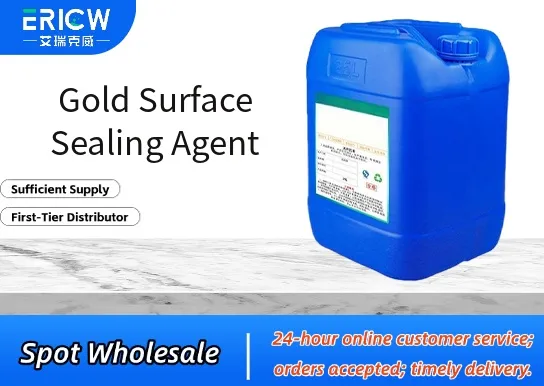
Non-reactive, inert formulation preserves gold’s optical and electrical integrity without discoloration or tarnishing.
Ultra-thin film formation (<0.5 µm) ensures minimal impact on dimensional tolerances and surface conductivity.
Solvent-free, low-VOC composition meets stringent occupational health and cleanroom handling requirements.
Thermally stable up to 200°C for compatibility with post-processing steps including soldering and thermal cycling.
Fast ambient-cure capability (tack-free in ≤30 min, full cure in 24 h at 23°C/50% RH).
Protective coating for gold-plated electrical contacts in aerospace avionics and satellite communication systems.
Surface passivation of gold bond pads and wire-bonding areas in high-reliability semiconductor packaging.
Corrosion barrier for gold-finished medical device electrodes and implantable sensor interfaces.
Temporary protective layer during precision machining or laser marking of gold-coated optical components.
Sealing agent for gold-decorated luxury watch components requiring long-term aesthetic stability.
| Chemical Type | Acrylated silicone hybrid resin |
| Product Form | Clear, low-viscosity liquid (solvent-free) |
| Appearance | Water-white, optically transparent |
| Melting Point / Softening Range | No distinct melting point; glass transition (Tg) ≈ –45°C |
| Primary Applications | Passivation & environmental sealing of thin-film gold surfaces |
| Key Features | Non-yellowing, UV-stable, halogen-free, non-ionic |
| Benefits | Preserves surface resistivity, enables reworkability, complies with IPC-CC-830B Class B |
| Regulatory Compliance | RoHS 2015/863/EU compliant; REACH SVHC candidate list free |
| Common Compatible Systems | Suitability |
| Au/Ni/Cu multilayer PCB finishes | Highly Recommended – Forms uniform, pinhole-free films without interfacial delamination |
| Epoxy-based underfill encapsulants | Recommended – Compatible with standard cure profiles; no adverse interdiffusion observed |
| Plasma-cleaned gold substrates (O₂/Ar) | Highly Recommended – Enhances adhesion and film continuity |
| UV-curable conformal coatings (acrylic type) | Suitable – Can be overcoated after full thermal cure; requires 24-h intercoat interval |
Q1: What is the CAS Registry Number for Gold Surface Sealing Agent?
A: This is a proprietary multi-component formulation; individual CAS numbers are assigned only to pre-approved raw materials per REACH Annex VI. Full compositional disclosure is restricted under trade secret provisions.
Q2: What is the recommended application thickness and coverage rate?
A: Optimal dry-film thickness is 0.3–0.5 µm. Typical coverage is 8–12 m² per liter (depending on substrate roughness and application method: spray, dip, or selective dispensing).
Q3: How does it compare to conventional benzotriazole (BTA) inhibitors for gold protection?
A: Unlike BTA—whose protection relies on reversible chemisorption and leaches under humidity—this agent forms a covalently anchored, hydrophobic barrier with no migration risk and superior long-term stability in 85°C/85% RH testing.
Q4: Is extraction testing data available for medical device applications?
A: Yes. USP <788> particulate matter and ISO 10993-12 extractables testing (using 50% ethanol/water at 50°C for 72 h) confirm total organic extractables < 1.2 µg/cm²; no detectable heavy metals or mutagenic impurities.
Contact With Us:
E-mail: wangxingqiang@ericwchem.com
Have a Questions? Call Us:
Add:
Building A1, Jiete Industrial Park, Huangpu District, Guangzhou City, Guangdong Province, China