English
 Español
 tiếng việt
 русский
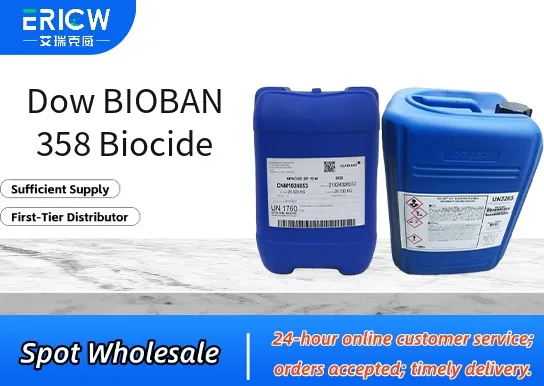
Broad-spectrum efficacy against bacteria, fungi, and algae in water-based systems.
Stable across a wide pH range (pH 4–10), ensuring consistent performance in diverse formulations.
Low volatility and minimal odor, enhancing workplace safety and user acceptance.
Compatible with common surfactants, thickeners, and other formulation ingredients.
Non-oxidizing mode of action, reducing corrosion risk to metal components in industrial systems.
Preservation of water-based paints and coatings during storage and application.
Protection of adhesives and sealants against microbial degradation.
Control of microorganisms in metalworking fluids and coolants.
Stabilization of architectural and industrial latex emulsions.
Maintenance of hygiene in process water systems for non-food-contact industrial use.
| Chemical Type | Isothiazolinone-based biocide (active ingredient: 2-methylisothiazolin-3-one and 5-chloro-2-methylisothiazolin-3-one) |
| Product Form | Aqueous solution |
| Appearance | Clear, light yellow to amber liquid |
| pH (1% aqueous solution) | 2.0–4.0 |
| Density (at 20°C) | 1.05–1.10 g/cm³ |
| Solubility | Completely miscible with water |
| Primary Applications | Preservative for water-based industrial formulations |
| Key Features | Broad-spectrum antimicrobial activity, low effective dosage, formulation stability |
Q1: What is the primary mode of action for Dow BIOBAN 358 Biocide?
A: Dow BIOBAN 358 Biocide functions primarily as a broad-spectrum antimicrobial agent effective against bacteria, yeasts, and molds. Its activity is attributed to its ability to disrupt essential cellular processes, including membrane integrity and metabolic function, leading to microbial growth inhibition or inactivation.
Q2: In which types of industrial formulations is Dow BIOBAN 358 Biocide commonly used?
A: It is widely incorporated into water-based industrial products such as metalworking fluids, latex paints and coatings, adhesives, sealants, construction chemicals, and cleaning solutions—particularly where long-term preservation against microbial spoilage is required during storage and use.
Q3: Is Dow BIOBAN 358 Biocide compatible with common formulation ingredients?
A: Yes, it demonstrates good compatibility with many anionic, nonionic, and amphoteric surfactants, thickeners, and pH buffers typically found in industrial aqueous systems. However, compatibility should always be verified experimentally under actual formulation conditions, especially in the presence of strong oxidizers or highly alkaline components.
Q4: How should Dow BIOBAN 358 Biocide be added to a formulation?
A: It is recommended to add Dow BIOBAN 358 Biocide during the cool-down phase of manufacturing, after high-temperature processing steps and near the end of the batch cycle, to preserve its stability and efficacy. Pre-dilution with water or a compatible solvent may facilitate uniform dispersion, particularly in viscous systems.
Q5: What safety and handling precautions should be observed?
A: As with all industrial biocides, appropriate personal protective equipment—including gloves, eye protection, and adequate ventilation—should be used during handling. Consult the Safety Data Sheet (SDS) for detailed toxicological information, first-aid measures, and disposal guidance prior to use.
Contact With Us:
E-mail: wangxingqiang@ericwchem.com
Have a Questions? Call Us:
Add:
Building A1, Jiete Industrial Park, Huangpu District, Guangzhou City, Guangdong Province, China