English
 Español
 tiếng việt
 русский
Excellent melt processability for extrusion and injection molding
High tensile strength and elongation at break for demanding flexible applications
Good resistance to oils, greases, and common industrial fluids
Consistent batch-to-batch performance with tight molecular weight distribution
Low-temperature flexibility down to –40 °C without significant stiffness increase
Automotive interior trim components (e.g., soft-touch surfaces, seals)
Industrial hoses and fluid-conveyance tubing
Wear-resistant protective covers for electronics and medical devices
Flexible connectors and gaskets requiring dynamic flex life
High-clarity, abrasion-resistant films for packaging and specialty laminates
| Chemical Type | Thermoplastic Polyurethane (TPU), Polyester-based |
| Product Form | Pellets |
| Appearance | Off-white to light tan, free-flowing pellets |
| Primary Applications | Extruded profiles, injection-molded parts, calendered films |
| Key Features | Processing versatility, mechanical toughness, oil resistance |
| Benefits | Reduced scrap in high-speed processing; extended service life under cyclic stress |
| Density (g/cm³) | 1.18–1.22 |
| Melt Flow Rate (230 °C/2.16 kg, g/10 min) | 10–14 |
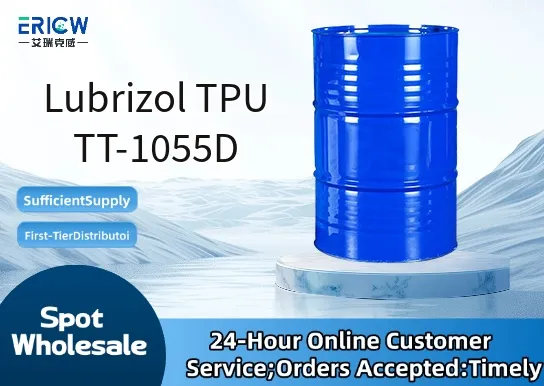
Q1: What is Lubrizol TPU TT-1055D primarily used for?
A: Lubrizol TPU TT-1055D is a thermoplastic polyurethane-based additive designed to enhance melt processability, surface finish, and low-temperature flexibility in TPU compounds—particularly in extrusion and injection molding applications for automotive interior trim, soft-touch overmolding, and technical elastomer parts.
Q2: Is TT-1055D compatible with all TPU grades?
A: TT-1055D demonstrates broad compatibility with aromatic and aliphatic TPU resins, including polyester- and polyether-based systems. Optimal performance is typically observed when blended with medium-to-high molecular weight TPUs; compatibility testing under end-use processing conditions is recommended for critical applications.
Q3: How is TT-1055D incorporated into TPU formulations?
A: TT-1055D is typically introduced via dry blending or side-stream feeding prior to extrusion or injection molding. It disperses readily during melt processing and does not require pre-drying beyond standard TPU handling practices. Dosage depends on formulation requirements but generally ranges from 0.1% to 2% by weight of the base TPU.
Q4: Does TT-1055D affect the mechanical properties of finished TPU parts?
A: At typical use levels, TT-1055D maintains key mechanical attributes—including tensile strength, elongation at break, and abrasion resistance—while improving flow and surface aesthetics. Significant reductions in hardness or modulus are not expected unless used well above recommended dosage ranges.
Contact With Us:
E-mail: wangxingqiang@ericwchem.com
Have a Questions? Call Us:
Add:
Building A1, Jiete Industrial Park, Huangpu District, Guangzhou City, Guangdong Province, China