English
 Español
 tiếng việt
 русский
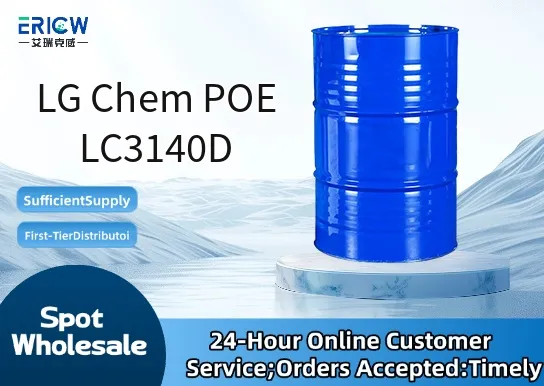
Outstanding long-term thermal and oxidative stability for extended service life in demanding environments.
Excellent low-temperature flexibility and impact resistance down to –40 °C.
Superior compatibility with polypropylene (PP) and polyethylene (PE), enabling seamless blending and enhanced phase adhesion.
Low extractables and high purity, meeting stringent requirements for food-contact and medical-grade applications.
Consistent melt flow behavior and excellent processability via injection molding, extrusion, and blow molding.
Automotive interior trim components requiring soft-touch feel and dimensional stability.
Flexible packaging films where seal integrity and puncture resistance are critical.
Toughened polypropylene compounds for under-hood automotive parts.
Medical tubing and connectors requiring biocompatibility and sterilization resistance.
Consumer electronics housings requiring impact absorption and aesthetic surface finish.
| Chemical Type | Polyolefin Elastomer (POE), ethylene-octene copolymer |
| Product Form | Pellets |
| Appearance | Off-white, free-flowing granules |
| Primary Applications | PP/PE toughening, soft-touch overmolding, flexible packaging, medical devices |
| Key Features | High elasticity, low compression set, excellent weatherability |
| Benefits | Improved impact strength, reduced part weight, enhanced recyclability vs. TPEs |
| Melt Flow Index (190 °C/2.16 kg) | 1.5–2.5 g/10 min |
| Density (ASTM D792) | 0.870–0.875 g/cm³ |
Q1: What is the primary function of LG Chem POE LC3140D in polymer formulations?
A: LG Chem POE LC3140D is an ethylene-octene copolymer elastomer designed primarily as a toughening agent and impact modifier for polyolefin-based systems, especially in PP and HDPE compounds requiring enhanced flexibility, low-temperature ductility, and balanced stiffness-toughness performance.
Q2: Is LC3140D compatible with common polypropylene homopolymers and copolymers?
A: Yes, LC3140D exhibits excellent compatibility with a broad range of polypropylene resins—including homopolymers, random copolymers, and impact copolymers—enabling uniform dispersion and effective phase adhesion without requiring additional compatibilizers in most standard compounding processes.
Q3: How does LC3140D perform under thermal processing conditions typical for injection molding or extrusion?
A: LC3140D demonstrates good thermal stability and melt processability across conventional polyolefin processing temperatures (typically 180–240 °C), maintaining consistent rheological behavior and minimal degradation during repeated shear exposure in twin-screw compounding or high-speed molding operations.
Q4: Can LC3140D be used in applications requiring food-contact compliance?
A: While LC3140D is manufactured using GMP-aligned processes and contains no intentionally added heavy metals or restricted plasticizers, formal regulatory clearance for food-contact applications depends on final formulation, processing conditions, and regional regulatory review—users should conduct full migration and compliance assessments as part of their qualification process.
Q5: What are the recommended drying requirements prior to processing?
A: LC3140D is hydrophobic and typically requires minimal drying; however, for optimal surface quality and mechanical consistency—especially in high-humidity environments—it is advisable to dry at 60–80 °C for 2–4 hours prior to processing.
Contact With Us:
E-mail: wangxingqiang@ericwchem.com
Have a Questions? Call Us:
Add:
Building A1, Jiete Industrial Park, Huangpu District, Guangzhou City, Guangdong Province, China