English
 Español
 tiếng việt
 русский
High thermal stability up to 800 °C, suitable for high-temperature processing and firing applications.
Excellent lightfastness and weather resistance, ensuring long-term color retention under UV exposure.
Non-toxic, heavy-metal-free formulation compliant with global regulatory standards including EN 71-3 and RoHS.
Superior dispersion performance in aqueous and solvent-based systems with low oil absorption.
Consistent batch-to-batch color strength and hue, supported by strict in-house quality control.
Ceramic glazes and underglaze decorations for tableware and architectural tiles.
Coloration of vitreous enamels for domestic appliances and industrial metal coatings.
Pigmentation of refractory materials including furnace linings and kiln furniture.
Functional coloring in high-performance concrete and cementitious architectural precast elements.
Stabilized pigment dispersions for industrial powder coatings requiring heat resistance.
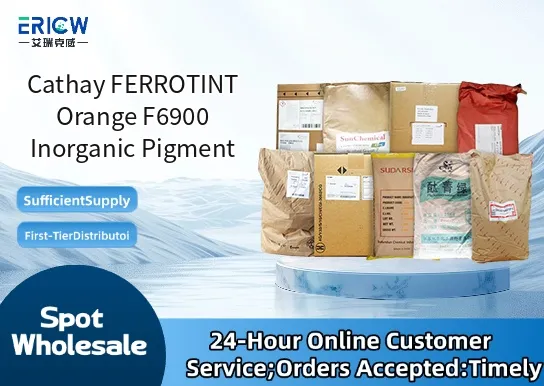
| Chemical Type | Complex iron oxide-based inorganic pigment (α-Fe₂O₃ modified) |
| Product Form | Fine dry powder |
| Appearance | Free-flowing orange-red powder with uniform particle distribution |
| Primary Applications | Ceramics, enamels, refractories, architectural concrete, high-temp coatings |
| Key Features | Heat stable, lightfast, chemically inert, non-volatile, pH-stable |
| Particle Size (D50) | 0.8–1.2 µm (by laser diffraction) |
| Specific Surface Area | 8–12 m²/g (BET method) |
| Ignition Loss (1000 °C) | < 1.0 wt% |
Q1: What is the primary chemical composition of Cathay FERROTINT Orange F6900?
A: Cathay FERROTINT Orange F6900 is a high-performance inorganic pigment based on modified iron oxide–zinc oxide complex chemistry, engineered for enhanced chroma and thermal stability. It contains no heavy metals such as lead, cadmium or chromium(VI), and is formulated to meet global regulatory expectations for restricted substances.
Q2: Is this pigment suitable for use in food-contact plastics or coatings?
A: Cathay FERROTINT Orange F6900 is designed for general industrial applications including architectural coatings, industrial finishes, and engineering plastics. While it complies with major global restrictions on hazardous substances, it is not pre-qualified for direct food-contact applications under specific food safety regulations — end-use compliance must be verified by the formulator through full system testing and regulatory review.
Q3: How does F6900 perform under elevated processing temperatures?
A: This pigment exhibits excellent thermal stability and retains its orange hue without significant darkening or fading during standard polymer processing conditions, including extrusion and injection molding up to approximately 280 °C. Performance may vary depending on residence time, shear history, and resin matrix.
Q4: What dispersion methods are recommended for optimal color development?
A: For best results, pre-disperse F6900 using high-shear mixing or bead milling in compatible solvents or carrier resins. Its inorganic nature requires adequate wetting and deagglomeration — compatibility with common dispersants (e.g., polymeric or phosphate-based) should be confirmed during formulation development.
Q5: Can F6900 be used alongside organic pigments or other inorganic pigments in blends?
A: Yes, F6900 demonstrates good compatibility in mixed-pigment systems and is frequently blended with other iron oxide-based or spinel-type inorganic pigments to fine-tune shade and opacity. When combining with organic pigments, assess potential interactions—especially pH sensitivity or reducing environments—that could affect long-term color stability.
Contact With Us:
E-mail: wangxingqiang@ericwchem.com
Have a Questions? Call Us:
Add:
Building A1, Jiete Industrial Park, Huangpu District, Guangzhou City, Guangdong Province, China