English
 Español
 tiếng việt
 русский
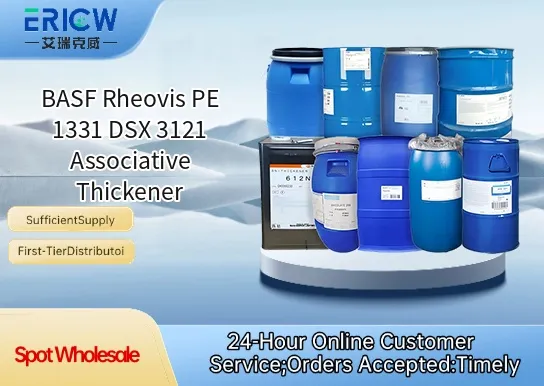
High-efficiency associative thickening for waterborne systems with excellent rheology control.
Delivers outstanding sag resistance and anti-drip performance in vertical applications.
Provides excellent compatibility with anionic surfactants and common co-thickeners.
Enables low-shear viscosity build-up while maintaining good flow and leveling properties.
Offers robust freeze-thaw stability and long-term storage performance in architectural coatings.
Interior and exterior architectural paints (latex-based).
Waterborne decorative coatings and wall finishes.
Textured coatings and stucco-like formulations.
Primer and undercoat systems requiring high solids content and low sag.
Industrial maintenance coatings for metal and masonry substrates.
| Chemical Type | Hydrophobically modified ethoxylated urethane (HEUR) associative thickener |
| Product Form | Aqueous dispersion |
| Appearance | Opaque white to off-white liquid |
| pH (1% aqueous solution) | 7.0 – 8.5 |
| Active Content (wt%) | 30.0 – 32.0% |
| Viscosity (Brookfield RVT, spindle #3, 20 rpm, 25°C) | 500 – 2,500 mPa·s |
| Key Features | Non-ionic, low-VOC, APEO-free |
| Primary Applications | Architectural coatings, textured finishes, primers |
Q1: What type of rheology does Rheovis PE 1331 DSX 3121 provide in waterborne formulations?
A: Rheovis PE 1331 DSX 3121 is an associative polyurethane (HEUR) thickener that delivers strong pseudoplastic (shear-thinning) behavior, providing excellent viscosity build at low shear while enabling good flow, leveling, and sprayability at high shear.
Q2: Is this thickener compatible with common surfactants and co-thickeners used in architectural coatings?
A: Yes — Rheovis PE 1331 DSX 3121 exhibits good compatibility with nonionic and anionic surfactants, as well as with cellulosic thickeners and other associative types. However, formulation screening is recommended to confirm stability and performance synergy in specific systems.
Q3: How should Rheovis PE 1331 DSX 3121 be incorporated into a formulation for optimal performance?
A: It is typically added during the let-down stage, after pigments and fillers are dispersed, under moderate agitation. Pre-dilution with water or a compatible solvent may aid uniform dispersion. Avoid excessive high-shear mixing post-addition to preserve its associative network structure.
Q4: Does this thickener offer resistance to microbial degradation?
A: As a synthetic polyurethane-based polymer, Rheovis PE 1331 DSX 3121 is inherently non-nutritive and highly resistant to enzymatic and microbial breakdown — eliminating the need for additional biocides solely for thickener stabilization.
Q5: Can it be used in low-VOC or zero-VOC formulations?
A: Yes — Rheovis PE 1331 DSX 3121 contains no volatile organic compounds and is widely used in low- and zero-VOC architectural and industrial coatings without compromising regulatory compliance or performance.
Contact With Us:
E-mail: wangxingqiang@ericwchem.com
Have a Questions? Call Us:
Add:
Building A1, Jiete Industrial Park, Huangpu District, Guangzhou City, Guangdong Province, China