English
 Español
 tiếng việt
 русский
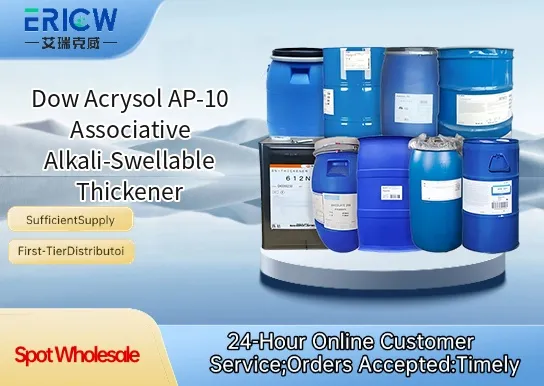
Delivers high-shear viscosity control and excellent sag resistance in waterborne coatings.
Provides outstanding flow and leveling performance without compromising brushability or rollability.
Offers superior compatibility with anionic surfactants and common co-thickeners such as HEC and HASE types.
Enables robust rheology modulation across a wide pH range (pH 7–10), activated efficiently by common alkaline builders.
Delivers low VOC contribution and supports formulation flexibility in eco-friendly architectural and industrial coatings.
Interior and exterior flat, eggshell, and satin architectural paints.
Waterborne industrial maintenance coatings for metal and concrete substrates.
Low-VOC decorative wall coatings and texture finishes.
Stain-blocking primers and universal base paints.
Water-based wood stains and clear finishes requiring non-drip rheology.
| Chemical Type | Associative alkali-swellable emulsion (ASE) |
| Product Form | Aqueous dispersion |
| Appearance | Opaque white liquid |
| pH (as received) | 2.5–3.5 |
| Active Content (wt%) | 25–27% |
| Viscosity (Brookfield RVT, spindle #2, 20 rpm, 25°C) | 500–1,500 cP |
| Primary Applications | Architectural and industrial waterborne coatings |
| Key Features | Non-ionic associative thickening, alkali-activated, shear-thinning behavior |
Q1: How does AP-10 differ from conventional non-associative alkali-swellable thickeners (ASE)?
A: Unlike traditional ASE thickeners, AP-10 features associative functionality—its polymer chains contain hydrophobic groups that interact with surfactants and other hydrophobes in the formulation. This provides enhanced rheology control, improved sag resistance, better leveling, and superior shear-thinning behavior, especially in low-VOC and high-solids systems.
Q2: What is the recommended neutralization method for optimal viscosity development?
A: AP-10 requires alkaline neutralization to fully swell and develop viscosity. Common neutralizing agents include AMP-95™, sodium hydroxide, or triethanolamine. Neutralization is typically performed at pH 8.0–9.5; viscosity build is most efficient when neutralization occurs after dilution and under moderate agitation to ensure uniform dispersion.
Q3: Is AP-10 compatible with common co-thickeners and rheology modifiers?
A: Yes—AP-10 is frequently used in combination with cellulosic thickeners (e.g., HEC) or hydrophobically modified ethoxylated urethanes (HEUR) to balance viscosity profile, improve application properties, and enhance storage stability. Compatibility should be verified in the final formulation due to potential interactions with high levels of surfactants or certain biocides.
Q4: How does AP-10 perform in high-electrolyte environments, such as cementitious or grout formulations?
A: AP-10 exhibits good tolerance to moderate levels of electrolytes, making it suitable for many construction-related applications. However, viscosity may decrease significantly in highly ionic systems; formulation optimization—including neutralization timing, co-thickener selection, and electrolyte management—is recommended for robust performance.
Contact With Us:
E-mail: wangxingqiang@ericwchem.com
Have a Questions? Call Us:
Add:
Building A1, Jiete Industrial Park, Huangpu District, Guangzhou City, Guangdong Province, China