English
 Español
 tiếng việt
 русский
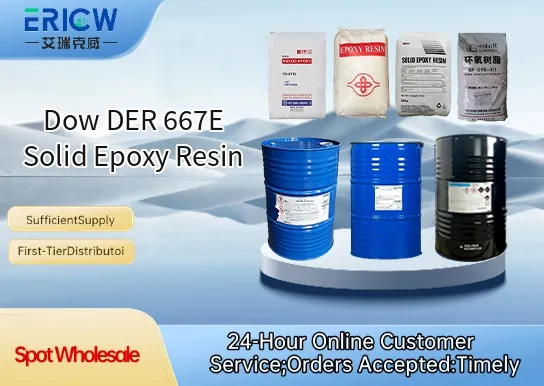
High molecular weight solid epoxy resin with excellent thermal stability and low melt viscosity.
Outstanding chemical resistance to acids, alkalis, and solvents after proper curing.
Provides superior mechanical strength and dimensional stability in cured formulations.
Compatible with a wide range of amine, anhydride, and phenolic hardeners for versatile cure systems.
Low extractables and minimal volatile organic content (VOC), supporting compliance with industrial safety standards.
Electrical encapsulation and potting compounds for transformers, reactors, and high-voltage components.
Structural adhesives for aerospace and automotive composite bonding.
High-performance powder coatings for metal substrates requiring corrosion and wear resistance.
Prepregs and laminates in printed circuit board (PCB) base materials.
Tooling resins for molds and master models used in composites manufacturing.
| Chemical Type | Bisphenol-A based solid epoxy resin |
| Product Form | Pale yellow to amber solid flakes or pellets |
| Epoxy Equivalent Weight (EEW) | 475–495 g/eq |
| Melt Viscosity (150 °C) | 8,000–12,000 cP |
| Softening Point | 82–88 °C |
| Chloride Content | ≤ 800 ppm |
| Volatiles (125 °C, 2 hrs) | ≤ 0.3 wt% |
| Primary Applications | Encapsulation, structural adhesives, powder coatings, prepregs |
Q1: What is the typical physical form and handling characteristics of Dow DER 667E?
A: Dow DER 667E is supplied as a pale yellow to amber solid in flake or pellet form. It is non-tacky at room temperature and exhibits good flow and dust-free handling properties, making it suitable for automated feeding systems in industrial compounding operations.
Q2: How does Dow DER 667E differ from liquid epoxy resins in terms of formulation benefits?
A: As a solid resin with low volatile content, Dow DER 667E enables higher solids formulations, reduced VOC emissions during processing, and improved shelf-life stability compared to many liquid alternatives. Its defined melting point also supports precise thermal control during melt-mixing and extrusion.
Q3: Is Dow DER 667E compatible with common epoxy curing agents?
A: Yes — Dow DER 667E is fully compatible with standard amine, anhydride, phenolic, and catalytic curing agents used in thermoset epoxy systems. Compatibility and cure kinetics should be verified experimentally based on the specific formulation and end-use performance requirements.
Q4: Can Dow DER 667E be used in powder coating applications?
A: Yes — its solid nature, narrow particle size distribution (when milled), and controlled melt viscosity make Dow DER 667E well-suited for use in high-performance thermosetting powder coatings, particularly where enhanced storage stability and film uniformity are required.
Q5: What are key storage and handling recommendations for this resin?
A: Store in original sealed packaging at temperatures below 30 °C in a dry, well-ventilated area. Avoid prolonged exposure to humidity and elevated temperatures to prevent agglomeration or surface tack. Pre-drying is generally not required but may be considered if moisture-sensitive formulations are being developed.
Contact With Us:
E-mail: wangxingqiang@ericwchem.com
Have a Questions? Call Us:
Add:
Building A1, Jiete Industrial Park, Huangpu District, Guangzhou City, Guangdong Province, China