English
 Español
 tiếng việt
 русский
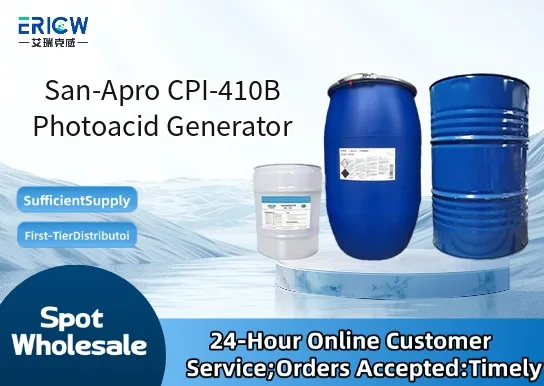
High quantum yield of acid generation under 365 nm (i-line) exposure, enabling efficient lithographic patterning.
Excellent thermal stability up to 200 °C, minimizing premature acid release during pre-bake and post-exposure bake steps.
Low volatility and negligible sublimation at standard processing temperatures, ensuring consistent film uniformity and reduced tool contamination.
High solubility in common photoresist casting solvents including PGMEA, ethyl lactate, and propylene glycol monomethyl ether.
Controlled acid strength (H₀ ≈ –2.8) optimized for chemically amplified resists requiring balanced deprotection kinetics and resolution.
i-line (365 nm) photolithography for semiconductor front-end-of-line (FEOL) and back-end-of-line (BEOL) patterning.
Advanced packaging lithography, including fan-out wafer-level packaging (FOWLP) and redistribution layer (RDL) fabrication.
MEMS and microfluidic device fabrication requiring high-resolution, low-line-edge-roughness (LER) resist profiles.
Flexible electronics manufacturing using polyimide or PET substrates with low-temperature process compatibility.
LED and power device patterning where high sensitivity and post-exposure delay (PED) stability are critical.
| Chemical Type | Sulfonium salt (triphenylsulfonium perfluorobutanesulfonate) |
| Product Form | White to off-white crystalline powder |
| Appearance | Free-flowing crystalline solid, no visible lumps or discoloration |
| Melting Point | 178–182 °C (DSC, onset) |
| Primary Applications | Chemically amplified positive-tone photoresists for i-line lithography |
| Key Features | High photospeed, low PED sensitivity, excellent shelf life (>24 months at 5 °C) |
| Benefits | Enables high-throughput patterning with improved LER control and reduced defectivity |
| Regulatory Compliance | REACH registered; RoHS 2015/863 compliant; no SVHCs above threshold |
| Common Compatible Systems | Suitability |
| Novolac resin-based i-line resists | Highly Recommended – Proven compatibility with standard novolac/diazonaphthoquinone (DNQ) systems as PAG additive |
| Polyhydroxystyrene (PHS)-based CARs | Highly Recommended – Optimized for t-BOC and acetal-type protecting groups with minimal side reactions |
| Acrylic polymer-based advanced resists | Recommended – Compatible with ester-functionalized acrylic backbones; may require minor formulation adjustment |
| Multi-component resist platforms (e.g., JSR, Shin-Etsu, Fujifilm formulations) | Suitable – Demonstrated performance in commercial benchmark formulations under controlled process windows |
Q1: What is the CAS Registry Number for San-Apro CPI-410B?
A: The CAS Registry Number for San-Apro CPI-410B is 126213-50-1 (triphenylsulfonium perfluorobutanesulfonate).
Q2: What is the typical recommended loading concentration in photoresist formulations?
A: Standard loading ranges from 1.5 to 4.0 wt% relative to total solid content, depending on resist matrix, target sensitivity, and process conditions—optimization via dose-to-clear testing is advised.
Q3: How does CPI-410B compare to triphenylsulfonium triflate (TPT) in terms of acid diffusion and resolution?
A: CPI-410B generates a less mobile perfluorobutanesulfonic acid versus triflic acid from TPT, resulting in reduced acid diffusion, tighter linewidth control, and lower LER—particularly beneficial for sub-0.5 µm features.
Q4: Is CPI-410B subject to migration or extractable residue concerns in final devices?
A: No significant migration or leaching has been observed under standard semiconductor backend processes (e.g., die attach, molding compound curing at ≤175 °C); extraction studies per JEDEC JESD22-A106 show <0.05 ppm residual sulfonate in aqueous simulant after 72 h at 40 °C.
Contact With Us:
E-mail: wangxingqiang@ericwchem.com
Have a Questions? Call Us:
Add:
Building A1, Jiete Industrial Park, Huangpu District, Guangzhou City, Guangdong Province, China