English
 Español
 tiếng việt
 русский
High reactivity with amine and anhydride hardeners, enabling rapid cure at ambient or elevated temperatures.
Excellent adhesion to metals, composites, and cured polymer substrates without extensive surface pretreatment.
Low viscosity (1200–1500 mPa·s at 25°C) for easy processing, impregnation, and void-free casting.
Superior electrical insulation properties with volume resistivity >1.0 × 10¹³ Ω·cm after full cure.
Good UV stability and long-term thermal resistance up to 130°C continuous use (UL 94 V-0 rated when formulated).
Electrical encapsulation and potting of power modules, transformers, and high-voltage sensors.
Structural adhesive formulations for aerospace composite bonding and automotive lightweight assemblies.
Matrix resin in filament-wound pressure vessels and carbon fiber reinforced tanks.
Underfill and glob-top materials for semiconductor packaging and MEMS device protection.
High-performance coating systems for corrosion-resistant linings in chemical process equipment.
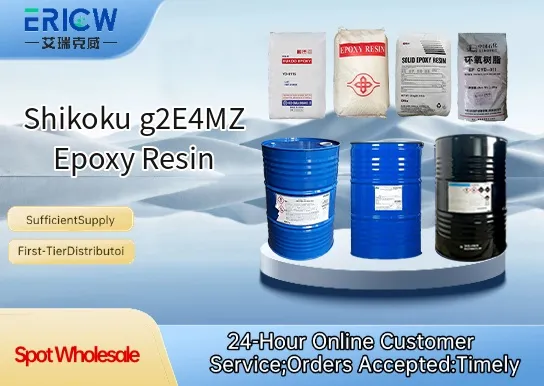
| Chemical Type | Diglycidyl ether of bisphenol-F (BPF-type epoxy) |
| Product Form | Clear, low-viscosity liquid |
| Appearance | Amber to pale yellow, transparent |
| Epoxy Equivalent Weight (EEW) | 178–185 g/eq |
| Viscosity (25°C) | 1200–1500 mPa·s |
| Chloride Content | ≤ 500 ppm |
| Softening Point | Not applicable (liquid at room temperature) |
| Primary Applications | Encapsulation, structural adhesives, composite matrices, protective coatings |
Q1: What is the primary functional role of Shikoku g2E4MZ in epoxy formulations?
A: Shikoku g2E4MZ is a reactive diluent designed to reduce viscosity while maintaining epoxy functionality. It enables improved processability—such as enhanced wetting and degassing—without significantly compromising crosslink density or thermal performance in cured systems.
Q2: Is g2E4MZ compatible with standard amine and anhydride curing agents?
A: Yes, g2E4MZ exhibits broad compatibility with common aliphatic and aromatic amines, as well as cyclic anhydrides. Its reactivity profile allows for integration into both room-temperature and elevated-temperature cure schedules without adverse side reactions or premature gelation.
Q3: How does g2E4MZ compare to conventional glycidyl ether diluents in terms of volatility and handling safety?
A: g2E4MZ features low volatility and negligible vapor pressure at ambient conditions, resulting in reduced inhalation exposure risk and improved workplace handling versus highly volatile mono-functional diluents. It is not classified as flammable under standard transport regulations.
Q4: Can g2E4MZ be used in applications requiring electrical insulation properties?
A: Yes—g2E4MZ contributes to stable dielectric performance in cured epoxy systems due to its low ionic impurity content and hydrolytic stability. It is commonly selected for encapsulation and potting formulations where long-term insulation integrity is critical.
Contact With Us:
E-mail: wangxingqiang@ericwchem.com
Have a Questions? Call Us:
Add:
Building A1, Jiete Industrial Park, Huangpu District, Guangzhou City, Guangdong Province, China