English
 Español
 tiếng việt
 русский
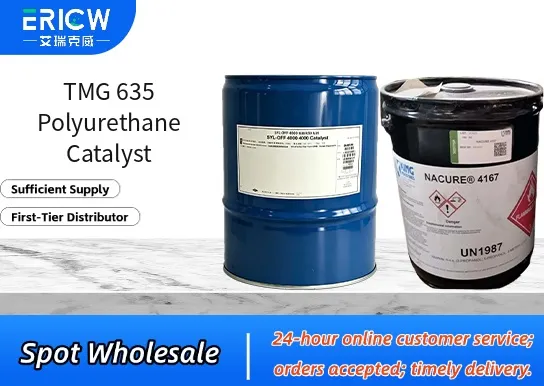
Highly selective amine catalyst for controlled urethane–urea reaction kinetics in polyurea and hybrid polyurethane systems.
Enables excellent pot life extension without compromising final cure speed or physical properties.
Low volatility and reduced odor profile, supporting safer handling and improved workplace air quality.
Compatible with aromatic and aliphatic isocyanates, offering formulation flexibility across diverse coating and elastomer applications.
Water-white liquid with consistent batch-to-batch performance and long-term storage stability.
Fast-curing polyurea spray coatings for corrosion protection on pipelines and infrastructure.
Reactive injection molding (RIM) of high-performance automotive bumpers and structural components.
High-solids polyurethane topcoats for industrial maintenance and marine applications.
Flexible and rigid polyurethane elastomers requiring precise reactivity balance between gelling and blowing reactions.
Moisture-cured polyurethane sealants and adhesives where controlled surface dry and deep cure are critical.
| Chemical Type | Tertiary amine catalyst (N,N-dimethylaminopropylamine derivative) |
| Product Form | Liquid |
| Appearance | Clear, water-white liquid |
| Density (20 °C) | ~0.89 g/cm³ |
| Viscosity (25 °C) | ~5–7 mPa·s |
| Flash Point (PMCC) | ~65 °C |
| Solubility | Miscible with common polyols, solvents, and isocyanates |
| Storage Stability | Stable for ≥12 months at 15–25 °C in sealed containers |
Q1: What is the primary function of TEGOAMIN SMP in polyurethane systems?
A: TEGOAMIN SMP is a highly selective, non-volatile tertiary amine catalyst designed to promote the urethane reaction (isocyanate–polyol coupling) while minimizing side reactions such as trimerization or hydrolysis. It supports balanced reactivity and improved processing control in flexible and rigid foam formulations.
Q2: Is TEGOAMIN SMP compatible with water-blown and MDI-based systems?
A: Yes — TEGOAMIN SMP demonstrates good compatibility with both water-blown and MDI-based polyurethane systems, including those used in slabstock, molded foams, and integral skin applications. Its low volatility and thermal stability support consistent performance across diverse process conditions.
Q3: How does TEGOAMIN SMP compare to traditional amine catalysts in terms of odor and fogging behavior?
A: As a non-volatile, high-molecular-weight amine derivative, TEGOAMIN SMP exhibits significantly reduced volatility compared to low-molecular-weight amines. This translates to lower potential for odor generation and minimal fogging in automotive and interior applications where emissions are critical.
Q4: What is the typical dosage range for TEGOAMIN SMP in PU foam formulations?
A: Dosage depends on formulation requirements and desired reactivity profile, but it is typically used at low concentrations — generally ranging from 0.1% to 2% by weight relative to the total polyol component. Optimization should be performed through lab-scale trials under representative processing conditions.
Contact With Us:
E-mail: wangxingqiang@ericwchem.com
Have a Questions? Call Us:
Add:
Building A1, Jiete Industrial Park, Huangpu District, Guangzhou City, Guangdong Province, China