English
 Español
 tiếng việt
 русский
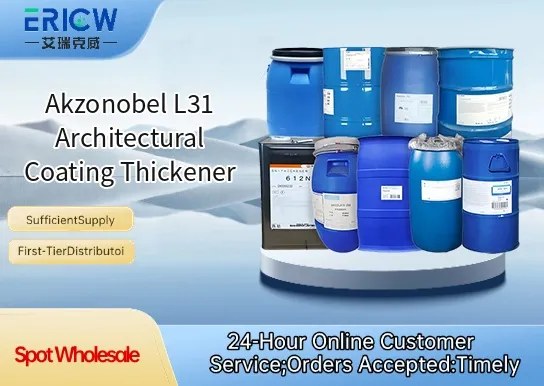
High-efficiency rheology modifier delivering excellent sag resistance in low-shear and high-shear conditions.
Compatible with both acrylic and vinyl-acrylic architectural emulsions, including PVA-based systems.
Provides outstanding storage stability and freeze-thaw resistance without compromising viscosity recovery.
Enables low-foam performance during high-speed mixing and application, supporting efficient production processes.
Offers excellent water retention and brush/roller drag control for superior application properties.
Interior and exterior latex wall paints.
Low-VOC and zero-VOC decorative coatings.
Textured finishes and stipple coatings.
Primer-sealers and undercoats for residential and commercial use.
Ready-mixed decorative coatings requiring consistent viscosity over shelf life.
| Chemical Type | Hydrophobically modified ethoxylated urethane (HEUR) |
| Product Form | Liquid concentrate |
| Appearance | Clear to slightly hazy, light amber liquid |
| pH (1% aqueous solution) | 6.5 – 7.5 |
| Active Content | 30 – 32 wt% |
| Viscosity (25°C, Brookfield RVT, spindle #3, 20 rpm) | 1,500 – 3,500 mPa·s |
| Primary Applications | Rheology control in waterborne architectural coatings |
| Key Benefits | Sag resistance, spatter control, leveling enhancement, and viscosity stability |
Q1: What is the primary function of AkzoNobel L31 in architectural coatings?
A: AkzoNobel L31 is a rheology modifier designed to provide efficient thickening and sag resistance in water-based architectural coatings, particularly enhancing viscosity at low shear while maintaining good flow and leveling at high shear.
Q2: Is L31 compatible with common architectural coating formulations?
A: Yes, L31 demonstrates broad compatibility with acrylic, vinyl-acrylic, and styrene-acrylic emulsions, as well as typical co-thickeners, biocides, and pigments used in interior and exterior wall paints — though compatibility testing in the final formulation is always recommended.
Q3: How should L31 be incorporated into a coating batch?
A: L31 is typically added during the let-down stage, either pre-diluted in water or directly dispersed under moderate agitation. It is not recommended for high-shear dispersion in the grind phase, as this may compromise its performance efficiency.
Q4: Does L31 offer any advantages over traditional associative thickeners?
A: Compared to many standard HEUR thickeners, L31 delivers improved water sensitivity control and enhanced compatibility with surfactants and coalescing agents, contributing to better film formation and reduced roller spatter in application.
Contact With Us:
E-mail: wangxingqiang@ericwchem.com
Have a Questions? Call Us:
Add:
Building A1, Jiete Industrial Park, Huangpu District, Guangzhou City, Guangdong Province, China