English
 Español
 tiếng việt
 русский
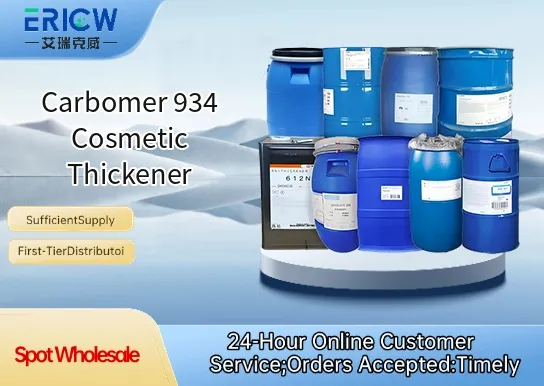
High-efficiency rheology modifier delivering excellent viscosity build and suspension stability in aqueous systems.
Provides outstanding clarity and transparency in final formulations, ideal for clear gels and serums.
Compatible with a broad range of cosmetic actives, preservatives, and electrolytes at low usage levels (0.1–1.0%).
Neutralized with TEA or NaOH to achieve optimal thickening performance and pH-responsive gelation.
Meets international cosmetic safety standards including USP/NF, EP, and ISO 22716-compliant manufacturing.
Clear facial gels and hydrating serums.
Shaving gels and after-shave soothing formulations.
Hand sanitizers and alcohol-based antiseptic gels.
Sunscreen lotions requiring high-shear stability and elegant skin feel.
Makeup removers and micellar water systems.
| Chemical Type | Crosslinked polyacrylic acid polymer |
| Product Form | White, free-flowing powder |
| Appearance | Off-white to white granular powder |
| Primary Applications | Water-based cosmetic gels, emulsions, and suspensions |
| Key Features | High thickening efficiency, excellent clarity, shear-thinning behavior |
| Benefits | Improved product stability, enhanced sensory profile, easy neutralization |
| Storage Conditions | Store in cool, dry place; protect from moisture and direct sunlight |
| Regulatory Status | INCI: Carbomer; compliant with COSMOS, EC 1223/2009, and FDA guidelines |
Q1: What is the primary functional role of Carbomer 934 in cosmetic formulations?
A: Carbomer 934 is a high-molecular-weight acrylic acid polymer primarily used as a rheology modifier—providing viscosity enhancement, suspension stabilization, and gel structure formation in aqueous and water-containing systems.
Q2: How is Carbomer 934 typically neutralized to achieve optimal thickening performance?
A: It requires neutralization with a suitable base—commonly triethanolamine (TEA), sodium hydroxide, or sodium bicarbonate—to ionize carboxylic acid groups and expand the polymer network. Neutralization is generally performed after full dispersion and swelling, often at pH 5.5–7.0 for stable performance.
Q3: Is Carbomer 934 compatible with common cosmetic ingredients such as surfactants, preservatives, and electrolytes?
A: It demonstrates good compatibility with nonionic and amphoteric surfactants, widely used preservatives, and many emollients. However, performance may be reduced in high-electrolyte systems or with strong cationic agents due to charge screening or precipitation risks—formulation testing is recommended.
Q4: What are key handling considerations when incorporating Carbomer 934 into a formulation?
A: To avoid agglomeration, it should be dispersed slowly under high-shear mixing into water or water-rich phases, followed by sufficient hydration time (typically 15–60 minutes) before neutralization. Premature neutralization or insufficient dispersion can lead to poor clarity, grittiness, or inconsistent viscosity.
Contact With Us:
E-mail: wangxingqiang@ericwchem.com
Have a Questions? Call Us:
Add:
Building A1, Jiete Industrial Park, Huangpu District, Guangzhou City, Guangdong Province, China