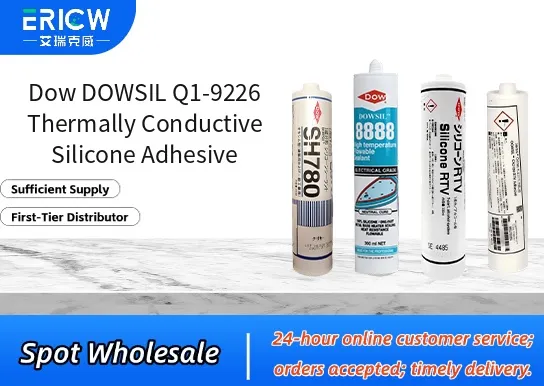
Features Of Dow DOWSIL Q1-9226 Thermally Conductive Silicone Adhesive
High thermal conductivity for efficient heat dissipation in demanding electronic assemblies.
Low modulus silicone formulation provides excellent stress relief and long-term reliability under thermal cycling.
Room-temperature vulcanizing (RTV) cure enables easy, tool-free application without oven baking.
Excellent adhesion to common substrates including aluminum, copper, ceramics, and FR-4 PCBs.
UL 94 V-0 rated for flame resistance, supporting safety-compliant designs.
Typical Applications Of Dow DOWSIL Q1-9226 Thermally Conductive Silicone Adhesive
Thermal bonding of power semiconductors (IGBTs, MOSFETs) to heat sinks in industrial inverters.
Attachment of LED modules and drivers in high-brightness lighting systems.
Die-attach and heat sink mounting in automotive ADAS and EV power electronics.
Thermal interface bonding in telecom base station RF power amplifiers.
Encapsulation and thermal management of sensors and control units in harsh-environment equipment.
Specifications Of Dow DOWSIL Q1-9226 Thermally Conductive Silicone Adhesive
| Chemical Type | Platinum-cured addition-cure silicone elastomer |
| Product Form | Paste (two-component, Part A + Part B) |
| Appearance | Off-white, homogeneous paste |
| Primary Applications | Structural thermal bonding and heat sink attachment |
| Key Features | Thermally conductive, electrically insulating, low modulus, RTV cure |
| Benefits | Reduces thermal resistance, absorbs mechanical stress, improves long-term reliability |
| Cure System | Addition cure (platinum catalyst), no by-products |
| UL Recognition | UL 94 V-0 (per UL 746C) |
Dow DOWSIL Q1-9226 Thermally Conductive Silicone Adhesive – Frequently Asked Questions (FAQ)
Q1: What are the primary application methods for DOWSIL Q1-9226?
A: DOWSIL Q1-9226 is typically applied via dispensing equipment—such as time-pressure or volumetric meter-mix systems—for precise control in bonding, potting, or gap-filling applications. It can also be manually applied using a syringe for low-volume prototyping or repair tasks.
Q2: How does this adhesive cure, and what conditions accelerate the process?
A: DOWSIL Q1-9226 cures at room temperature through moisture-cure chemistry, with full property development occurring over several days depending on thickness and ambient humidity. Elevated temperature (e.g., 60–80 °C) significantly reduces cure time and enhances crosslink density, especially for thicker sections.
Q3: Is DOWSIL Q1-9226 suitable for direct contact with electronic components such as power semiconductors or LED modules?
A: Yes—it is specifically formulated for thermal management in electronics, offering excellent dielectric strength, low ionic impurities, and long-term stability under thermal cycling. Its silicone base provides inherent resistance to thermal shock and mechanical stress at interfaces between dissimilar materials.
Q4: Can this adhesive be used in high-humidity or outdoor environments?
A: Yes—silicone chemistry provides outstanding resistance to moisture, UV exposure, and wide temperature extremes, making DOWSIL Q1-9226 well-suited for outdoor and harsh-environment applications where long-term reliability is critical.
 English
 Español
 tiếng việt
 русский