English
 Español
 tiếng việt
 русский
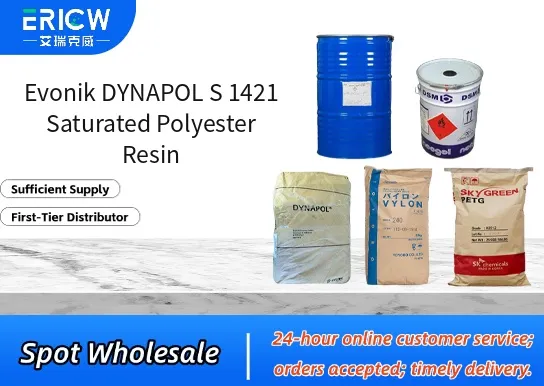
High chemical resistance to solvents, acids, and alkalis in cured coatings.
Excellent weathering stability and UV resistance for long-term outdoor performance.
Good flexibility combined with high hardness after crosslinking with melamine formaldehyde resins.
Low viscosity enables easy formulation into high-solids and low-VOC coating systems.
Consistent batch-to-batch reproducibility meeting stringent Evonik quality control standards.
Prefinished metal (coil coating) for architectural panels and appliance exteriors.
Automotive OEM and refinish clearcoats requiring gloss retention and chip resistance.
Industrial maintenance coatings for steel structures and equipment in aggressive environments.
High-performance powder coatings for outdoor furniture, fencing, and building components.
| Chemical Type | Saturated polyester resin (melamine-curable) |
| Product Form | Liquid, solvent-based solution |
| Appearance | Clear, pale yellow liquid |
| Non-Volatile Content (NV) | 58–62 % (by weight, 1 h at 130 °C) |
| Acid Value | 7–12 mg KOH/g |
| Hydroxyl Value | 45–55 mg KOH/g |
| Gardner Color | ≤ 3 |
| Primary Applications | High-durability coil, automotive, and industrial coatings |
Q1: What is the primary application of DYNAPOL S 1421 in coating systems?
A: DYNAPOL S 1421 is a saturated polyester resin designed primarily as a binder in high-performance powder coatings for architectural and industrial applications, where excellent flow, leveling, mechanical durability, and weather resistance are required.
Q2: Is DYNAPOL S 1421 compatible with standard curing agents used in polyester–TGIC and polyester–HAA systems?
A: Yes, DYNAPOL S 1421 is formulated to be compatible with common crosslinkers such as triglycidyl isocyanurate (TGIC) and hydroxyalkyl amide (HAA), enabling flexible formulation across conventional and low-temperature cure powder coating systems.
Q3: How does DYNAPOL S 1421 contribute to film formation and surface appearance in cured coatings?
A: Due to its well-balanced molecular weight distribution and low melt viscosity, DYNAPOL S 1421 promotes uniform film formation, smooth surface appearance, and minimal orange peel—especially important for high-gloss and metallic finishes.
Q4: Can DYNAPOL S 1421 be used in low-bake or UV-curable hybrid systems?
A: While DYNAPOL S 1421 is optimized for thermal curing, it can be incorporated into certain low-bake formulations when paired with reactive co-resins or catalysts—however, performance validation under specific process conditions is recommended prior to full-scale implementation.
Contact With Us:
E-mail: wangxingqiang@ericwchem.com
Have a Questions? Call Us:
Add:
Building A1, Jiete Industrial Park, Huangpu District, Guangzhou City, Guangdong Province, China