English
 Español
 tiếng việt
 русский
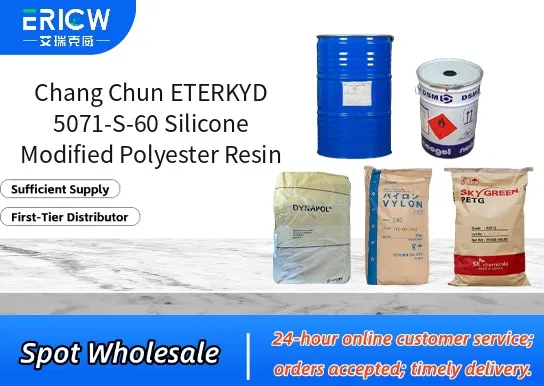
Enhanced thermal stability and long-term weather resistance due to silicone modification.
Excellent gloss retention and color stability under UV exposure and outdoor conditions.
Good compatibility with melamine formaldehyde crosslinkers for high-performance baking coatings.
Improved flexibility and impact resistance compared to conventional polyester resins.
Low viscosity profile enabling high-solids formulation and reduced VOC emissions.
High-durability coil coatings for architectural and industrial metal roofing panels.
Prefinished metal (PPM) coatings for HVAC components and appliance housings.
Baking enamels for automotive trim and non-structural exterior parts.
Industrial maintenance coatings requiring extended service life in harsh environments.
| Chemical Type | Silicone-modified polyester resin |
| Product Form | Liquid, solvent-based |
| Appearance | Clear to pale yellow transparent liquid |
| Non-Volatile Content (wt%) | 60 ± 1% |
| Viscosity (25°C, mPa·s) | 4,000 – 6,000 (Brookfield RV-DV2T, spindle #3, 20 rpm) |
| Acid Value (mg KOH/g) | 18 – 22 |
| Hydroxyl Value (mg KOH/g) | 120 – 140 |
| Recommended Solvent System | Aromatic hydrocarbons / ester blends (e.g., xylene, butyl acetate) |
Q1: What is the primary functional benefit of silicone modification in this polyester resin?
A: The silicone modification significantly enhances thermal stability, weather resistance, and surface hydrophobicity compared to conventional polyester resins, making it especially suitable for high-performance coil coating and exterior architectural coatings where long-term gloss retention and UV resistance are critical.
Q2: Is ETERKYD 5071-S-60 compatible with standard polyester crosslinkers such as TGIC or HAA-based systems?
A: Yes, it is formulated to be fully compatible with common amino crosslinkers including melamine-formaldehyde resins, as well as TGIC and HAA-type curing agents. Compatibility and cure response should be verified experimentally within the final formulation due to potential interactions with silicone segments.
Q3: How does the silicone content affect film flexibility and adhesion on metal substrates?
A: The controlled silicone incorporation maintains good substrate adhesion and bendability on cold-rolled steel and aluminum, without compromising mechanical integrity. Excessive silicone loading may reduce intercoat adhesion, so optimal performance is achieved when used within recommended formulation guidelines.
Q4: Can this resin be used in low-bake or ambient-cure systems?
A: While designed primarily for conventional thermal cure processes (e.g., 200–220°C for 2–5 minutes), it can be adapted to lower-bake conditions with appropriate catalyst selection and crosslinker optimization—though full property development typically requires sufficient thermal energy to ensure complete network formation.
Contact With Us:
E-mail: wangxingqiang@ericwchem.com
Have a Questions? Call Us:
Add:
Building A1, Jiete Industrial Park, Huangpu District, Guangzhou City, Guangdong Province, China