English
 Español
 tiếng việt
 русский
High thermal stability with continuous service up to 200 °C.
Excellent electrical insulation properties, including low dielectric loss and high volume resistivity.
Good compatibility with organic resins and pigments for hybrid formulation systems.
Low volatility and minimal outgassing under elevated temperature conditions.
Solvent-based liquid format enabling easy integration into coating, impregnation, and encapsulation processes.
Electrical insulation coatings for motors, transformers, and generators.
Heat-resistant varnishes for wire enamel and magnet wire treatment.
Matrix resin in high-temperature composite laminates and prepregs.
Binders for silicone rubber fillers and refractory ceramic coatings.
Protective topcoats for aerospace components exposed to thermal cycling.
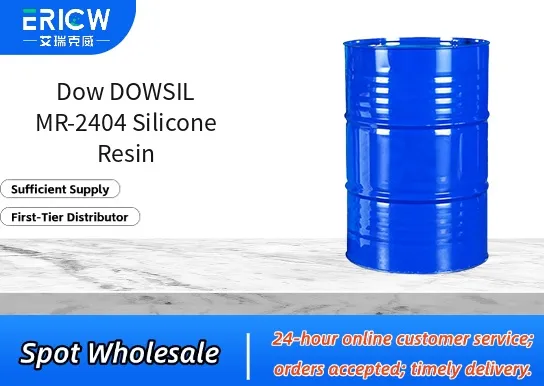
| Chemical Type | Methyl-phenyl silicone resin |
| Product Form | Liquid (solvent-based solution) |
| Appearance | Clear, colorless to pale yellow liquid |
| Primary Applications | High-temperature electrical insulation, protective coatings, hybrid composites |
| Key Features | Thermal stability, electrical insulation, solvent solubility, low outgassing |
| Benefits | Extended equipment lifetime, reduced failure risk under thermal stress, formulation flexibility |
| Solvent System | Aromatic hydrocarbons (e.g., xylene, Solvesso™) |
| VOC Content | Typical: ~650 g/L (as supplied) |
Q1: What is the primary function of DOWSIL MR-2404 in coating formulations?
A: DOWSIL MR-2404 is a methyl-phenyl silicone resin designed to enhance surface hardness, mar resistance, and thermal stability in high-performance coatings—particularly for industrial and automotive topcoats where durable, low-gloss finishes are required.
Q2: Is DOWSIL MR-2404 compatible with common organic resin systems?
A: Yes, it demonstrates good compatibility with acrylics, polyesters, and alkyds when properly dispersed or dissolved in aromatic or ketonic solvents. Compatibility should be verified experimentally in the final formulation due to variations in molecular weight and polarity of base resins.
Q3: How is DOWSIL MR-2404 typically incorporated into a coating system?
A: It is generally added during the let-down or grinding stage, either pre-dissolved in a suitable solvent or directly dispersed under high-shear mixing. Optimal incorporation ensures uniform distribution and avoids phase separation or haze formation in the cured film.
Q4: Does DOWSIL MR-2404 require heat curing to develop its full performance benefits?
A: While it contributes to ambient-cure film integrity, its thermal crosslinking potential becomes more pronounced above 120 °C. For maximum hardness and chemical resistance, thermal post-curing is recommended—especially in OEM or coil coating applications.
Contact With Us:
E-mail: wangxingqiang@ericwchem.com
Have a Questions? Call Us:
Add:
Building A1, Jiete Industrial Park, Huangpu District, Guangzhou City, Guangdong Province, China