English
 Español
 tiếng việt
 русский
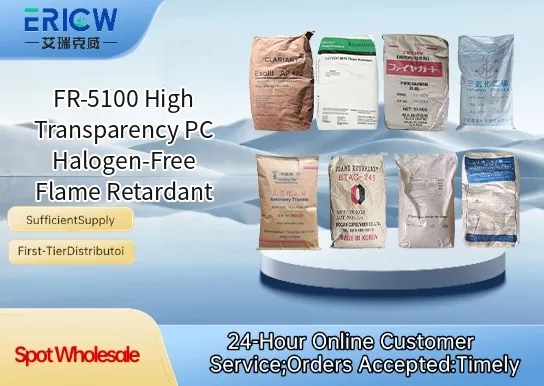
Exceptional optical clarity with >90% light transmittance (ASTM D1003), preserving the aesthetic integrity of transparent polycarbonate parts.
Halogen-free formulation ensures low smoke density and non-corrosive combustion gases, meeting stringent environmental and safety standards (IEC 61249-2-21, UL 94 V-0 at 1.5 mm).
Excellent thermal stability up to 320 °C, enabling compatibility with standard PC processing conditions (injection molding, extrusion) without degradation.
Low migration and blooming resistance, ensuring long-term surface quality and dimensional stability in demanding applications.
Good compatibility with aromatic polycarbonate resins, enabling uniform dispersion without requiring additional compatibilizers.
LED lighting housings and lens covers requiring both flame retardancy and high light transmission.
Transparent electronic enclosures for medical devices, industrial HMIs, and public kiosks.
Fire-rated glazing components in architectural and transportation interiors (e.g., train cabin partitions, elevator panels).
Optical-grade safety shields and protective faceguards compliant with EN 166 and ANSI Z87.1.
Transparent battery module covers for energy storage systems where halogen-free performance is mandated.
| Chemical Type | Organophosphorus-based flame retardant (phosphinate/phosphonate hybrid) |
| Product Form | Free-flowing white granules |
| Appearance | Off-white to pale yellow granules, homogeneous particle size distribution |
| Recommended Loading Level | 8–12 wt% in aromatic polycarbonate (e.g., Makrolon®, Lexan®) |
| UL 94 Rating (at 1.5 mm) | V-0 (self-extinguishing in ≤10 sec, no dripping) |
| Limiting Oxygen Index (LOI) | ≥38% (ASTM D2863) |
| Density | 1.35–1.42 g/cm³ (23 °C) |
| Storage Conditions | Store in cool (<30 °C), dry, well-ventilated area; protect from moisture and direct sunlight |
Q1: What makes FR-5100 suitable for high-clarity polycarbonate applications?
A: FR-5100 is specifically engineered to minimize light scattering and yellowing in PC matrices, preserving optical clarity and color fidelity—critical for lighting lenses, display covers, and transparent safety components.
Q2: How does FR-5100 achieve flame retardancy without halogen-based chemistry?
A: It utilizes a synergistic phosphorus-nitrogen system that promotes char formation and gas-phase radical quenching during combustion, delivering effective UL94 V-0 performance at low loading levels without corrosive or environmentally persistent halogen compounds.
Q3: Is FR-5100 compatible with common PC processing methods such as injection molding and extrusion?
A: Yes—FR-5100 exhibits excellent thermal stability and melt compatibility with standard polycarbonate resins, supporting conventional melt-processing conditions without significant degradation or plate-out issues.
Q4: Does FR-5100 affect the mechanical properties of PC, such as impact strength or tensile modulus?
A: When properly compounded, FR-5100 maintains balanced mechanical performance—impact resistance and dimensional stability remain largely unaffected, though optimal dispersion and formulation tuning are recommended to preserve baseline PC toughness.
Q5: What regulatory compliance advantages does FR-5100 offer compared to brominated alternatives?
A: As a halogen-free solution, FR-5100 supports compliance with evolving global restrictions on hazardous substances—including RoHS, REACH SVHC considerations, and WEEE directives—while avoiding concerns related to dioxin/furan formation during incineration or recycling.
Contact With Us:
E-mail: wangxingqiang@ericwchem.com
Have a Questions? Call Us:
Add:
Building A1, Jiete Industrial Park, Huangpu District, Guangzhou City, Guangdong Province, China