English
 Español
 tiếng việt
 русский
High thermal stability up to 250 °C continuous use temperature.
Excellent weather resistance and UV stability for long-term outdoor performance.
Good compatibility with organic resins and pigments for hybrid formulation systems.
Low surface energy enabling superior water repellency and anti-graffiti properties.
Solvent-based liquid form facilitating easy integration into coating and impregnation processes.
Water-repellent impregnation for concrete, natural stone, and masonry.
High-performance topcoats for architectural façades and façade renovation systems.
Heat-resistant coatings for industrial equipment and chimneys.
Hybrid silicone-acrylic facade paints requiring enhanced durability and breathability.
Anti-graffiti protective coatings for public infrastructure and cultural heritage surfaces.
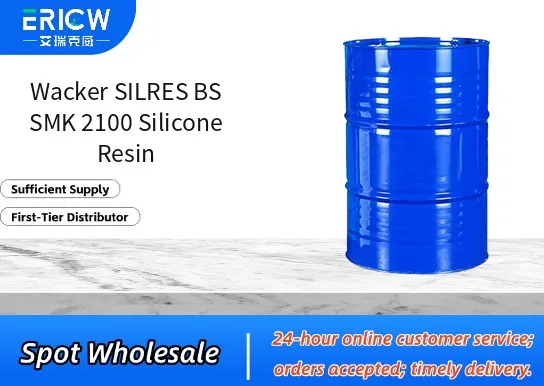
| Chemical Type | Methyl-phenyl silicone resin |
| Product Form | Liquid, solvent-based |
| Appearance | Clear to slightly yellowish viscous liquid |
| Solvent | Xylene / aromatic hydrocarbon mixture |
| Non-Volatile Content | Approx. 50 wt.% |
| Viscosity (25 °C) | Approx. 1,200–1,800 mPa·s |
| Density (20 °C) | Approx. 0.94–0.96 g/cm³ |
| Primary Applications | Protective coatings, impregnations, facade systems |
Q1: What is the primary function of SILRES BS SMK 2100 in coating formulations?
A: SILRES BS SMK 2100 is a methyl-phenyl silicone resin designed to enhance weather resistance, thermal stability, and surface hardness in high-performance organic coatings—particularly for industrial maintenance, architectural façades, and metal protection systems.
Q2: Is SILRES BS SMK 2100 compatible with common organic resins such as acrylics, alkyds, or polyurethanes?
A: Yes, it exhibits good compatibility with a broad range of organic binder systems. It is typically incorporated via solvent blending or high-shear mixing, and its reactivity allows for coalescence and crosslinking enhancement without requiring additional catalysts in most standard formulations.
Q3: How does SILRES BS SMK 2100 improve substrate adhesion and film integrity?
A: Its balanced methyl/phenyl ratio and controlled molecular architecture promote strong interfacial interaction with both polar substrates (e.g., metals, concrete) and organic polymer matrices, contributing to improved intercoat adhesion, reduced microcracking under thermal cycling, and enhanced cohesive strength in cured films.
Q4: What are the recommended storage conditions and shelf life for this product?
A: Store in tightly sealed original containers at temperatures between 5 °C and 30 °C, protected from moisture and direct sunlight. Under these conditions, the typical shelf life is 12 months from the date of manufacture, provided container integrity remains intact.
Contact With Us:
E-mail: wangxingqiang@ericwchem.com
Have a Questions? Call Us:
Add:
Building A1, Jiete Industrial Park, Huangpu District, Guangzhou City, Guangdong Province, China