English
 Español
 tiếng việt
 русский
Excellent abrasion resistance for extended service life in demanding mechanical environments.
Outstanding low-temperature flexibility down to –30 °C without significant loss of elasticity.
Good oil and grease resistance, maintaining dimensional stability in contact with hydrocarbon-based fluids.
High transparency and clarity, suitable for optical-grade and aesthetic applications.
Easy processability via extrusion, injection molding, and calendering with minimal thermal degradation.
Automotive interior trim components including instrument panel overlays and soft-touch surfaces.
Medical tubing and fluid-handling devices requiring biocompatibility and kink resistance.
High-performance sporting goods such as ski boot cuffs, protective padding, and wearable sensors.
Industrial hoses and pneumatic tubing where flexibility, pressure resilience, and chemical inertness are critical.
Consumer electronics casings and protective covers demanding impact absorption and surface gloss retention.
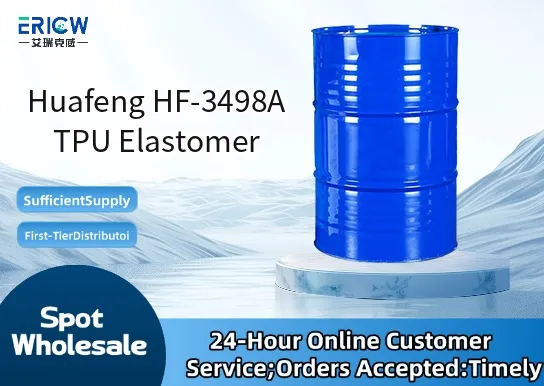
| Chemical Type | Aliphatic polyester-based thermoplastic polyurethane |
| Product Form | Pellets (free-flowing, uniform size) |
| Appearance | Translucent, light yellow to amber granules |
| Hardness (Shore A) | 85 ± 2 |
| Melt Flow Index (210 °C / 2.16 kg) | 12–15 g/10 min |
| Density | 1.18–1.20 g/cm³ |
| Key Features | Hydrolysis-resistant, UV-stabilized, non-yellowing |
| Primary Applications | Extruded profiles, molded parts, co-extruded films |
Q1: What are the key processing advantages of HF-3498A compared to conventional TPU grades?
A: HF-3498A offers enhanced melt flow stability and reduced torque demand during extrusion and injection molding, enabling smoother processing at lower barrel temperatures. Its balanced hardness and low melt viscosity support consistent profile formation and improved surface finish in thin-walled or complex geometries.
Q2: Is HF-3498A suitable for applications requiring good low-temperature flexibility and abrasion resistance?
A: Yes — HF-3498A is formulated to deliver excellent resilience and retention of mechanical properties down to -25 °C, along with high resistance to wear and scuffing. It is commonly selected for demanding dynamic applications such as automotive interior trims, protective gear components, and industrial rollers.
Q3: Can HF-3498A be co-extruded or overmolded with other thermoplastics?
A: HF-3498A demonstrates good interfacial adhesion with common engineering resins including ABS, PC, and PP when processed under optimized temperature and residence time conditions. Adhesion performance may be further enhanced through surface treatment or compatibilizer use depending on the substrate and end-use requirements.
Q4: How should HF-3498A be dried prior to processing?
A: Prior to melt processing, HF-3498A should be thoroughly dried using a desiccant dryer to reduce moisture content below 0.05%. Typical drying conditions are 80–90 °C for 3–4 hours; extended drying times or higher temperatures are not recommended to avoid thermal degradation.
Contact With Us:
E-mail: wangxingqiang@ericwchem.com
Have a Questions? Call Us:
Add:
Building A1, Jiete Industrial Park, Huangpu District, Guangzhou City, Guangdong Province, China