English
 Español
 tiếng việt
 русский
High melt flow index for excellent processability in injection molding and extrusion
Outstanding low-temperature impact resistance and flexibility
Superior compatibility with polypropylene (PP) and polyethylene (PE) for enhanced blend performance
Excellent long-term thermal oxidative stability
Low extractables and consistent rheological behavior for demanding automotive and medical applications
Automotive interior trim components including dashboards and door panels
Toughened polypropylene (TPP) compounds for structural and semi-structural parts
Flexible packaging films requiring seal integrity and toughness
Medical tubing and soft-touch overmolding for handheld devices
Weather-resistant elastomeric profiles for building and construction
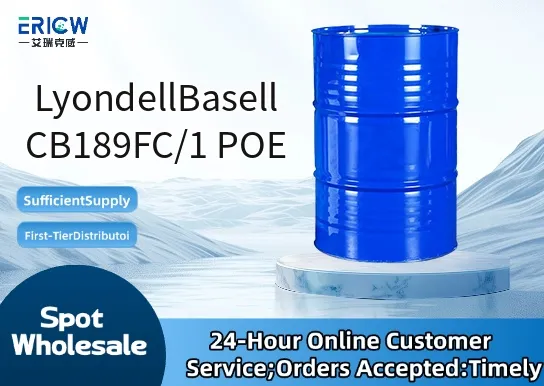
| Chemical Type | Polyolefin Elastomer (POE) |
| Product Form | Pellets |
| Appearance | Off-white to light beige, free-flowing pellets |
| Primary Applications | PP/PE toughening, soft-touch overmolding, flexible packaging |
| Key Features | High MFI, low density, excellent elasticity and clarity |
| Benefits | Improved impact strength at low temperatures, enhanced processing efficiency, reduced cycle times |
| Density (ASTM D792) | 0.865–0.870 g/cm³ |
| Melt Flow Index (190°C/2.16 kg, ASTM D1238) | 25–35 g/10 min |
Q1: What is the primary function of CB189FC/1 POE in polymer formulations?
A: CB189FC/1 is a polyolefin elastomer designed primarily as a toughening agent and impact modifier—especially for polypropylene-based systems—enhancing ductility, low-temperature impact resistance, and melt processability without significantly compromising stiffness or heat distortion temperature.
Q2: Is CB189FC/1 POE compatible with common polypropylene homopolymers and copolymers?
A: Yes, CB189FC/1 exhibits excellent compatibility with both PP homopolymers and random copolymers due to its ethylene-propylene backbone structure, enabling uniform dispersion and strong interfacial adhesion during melt blending—typically without requiring additional compatibilizers.
Q3: How does CB189FC/1 affect processing behavior in injection molding or extrusion?
A: This grade offers improved melt elasticity and reduced die swell compared to many conventional POEs, supporting stable extrusion output and good mold filling at standard processing temperatures. Its relatively narrow molecular weight distribution contributes to consistent rheology and lower viscosity sensitivity across shear rates.
Q4: Can CB189FC/1 be used in applications requiring FDA-compliant food-contact materials?
A: While CB189FC/1 itself is not pre-certified under any specific food-contact regulation, it is manufactured from monomers approved for indirect food contact use under relevant global frameworks. Final regulatory compliance depends on the full formulation, processing conditions, and end-use requirements—and must be verified by the compounder or end-user through appropriate testing and documentation.
Contact With Us:
E-mail: wangxingqiang@ericwchem.com
Have a Questions? Call Us:
Add:
Building A1, Jiete Industrial Park, Huangpu District, Guangzhou City, Guangdong Province, China