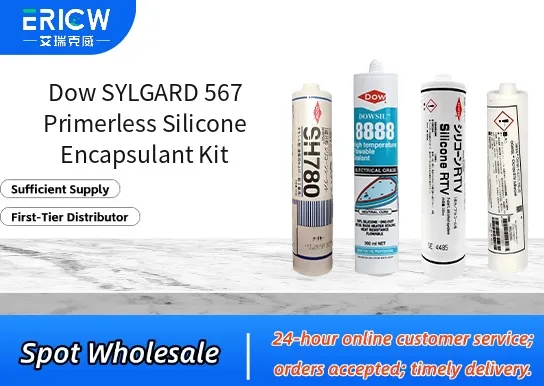
Primerless adhesion to a broad range of substrates including FR-4, aluminum, copper, and common plastics—eliminating pre-treatment steps and reducing process complexity.
Low-viscosity, two-part addition-cure silicone formulation enabling excellent flow, self-leveling, and void-free encapsulation of fine-pitch components.
Excellent thermal stability with continuous use temperature up to 200 °C and outstanding resistance to thermal cycling and mechanical stress.
UL 94 V-0 flammability rating and low ionic content for high reliability in sensitive electronic applications.
Non-corrosive, platinum-catalyzed cure system with no by-products—ideal for hermetic and optoelectronic assemblies requiring long-term stability.
Encapsulation and protection of power electronics modules, including IGBTs and SiC-based devices.
Underfill and edge bonding for LED packages and high-brightness lighting arrays.
Dielectric isolation and environmental protection of automotive sensors and ECUs exposed to under-hood conditions.
Conformal coating and potting of aerospace avionics and downhole oil & gas instrumentation.
Protection of flexible printed circuits (FPCs) and wearable electronics requiring soft, compliant encapsulation.
| Chemical Type | Platinum-catalyzed addition-cure silicone elastomer |
| Product Form | Two-component liquid kit (Part A: base; Part B: catalyst) |
| Appearance (Uncured) | Part A: translucent viscous liquid; Part B: translucent low-viscosity liquid |
| Mix Ratio (by weight) | 10:1 (A:B) |
| Cure Conditions | 1 hour at 150 °C or 24 hours at 25 °C (ambient cure possible with extended time) |
| Hardness (Shore A, cured) | 30–35 |
| Density (g/cm³, cured) | 1.15–1.18 |
| UL Recognition | UL 94 V-0 (per UL 746C), certified per UL File E309395 |
Q1: What does “primerless” mean for this encapsulant, and how does it benefit assembly processes?
A: “Primerless” indicates that SYLGARD 567 bonds directly to many common substrates—including polyimide, FR-4, aluminum, stainless steel, and certain plastics—without requiring a separate primer application. This eliminates an extra process step, reduces labor and material costs, and minimizes potential contamination or handling errors in high-reliability electronic assembly.
Q2: Can SYLGARD 567 be used for outdoor or harsh-environment applications?
A: Yes—SYLGARD 567 is formulated to provide long-term stability under thermal cycling, UV exposure, and humidity. Its silicone chemistry offers inherent resistance to weathering, ozone, and wide temperature extremes, making it suitable for demanding outdoor electronics, automotive sensors, and industrial control modules where environmental resilience is critical.
Q3: How does the two-part kit system work, and what mixing ratio should be used?
A: The kit consists of Part A (base polymer) and Part B (catalyst), supplied in a pre-measured 10:1 weight ratio. This fixed ratio ensures consistent cure performance and simplifies dispensing—no on-site weighing or ratio adjustment is required. Thorough but gentle mixing is recommended to avoid entrapping air.
Q4: Is SYLGARD 567 compatible with automated dispensing equipment?
A: Yes—the material exhibits excellent flow characteristics and low viscosity after mixing, supporting compatibility with standard piston-based and auger-type dispensers. Its controlled pot life and predictable gelation profile allow for reliable metering, bead placement, and encapsulation in high-throughput manufacturing environments.
Contact With Us:
E-mail: wangxingqiang@ericwchem.com
Have a Questions? Call Us:
Add:
Building A1, Jiete Industrial Park, Huangpu District, Guangzhou City, Guangdong Province, China
 English
 Español
 tiếng việt
 русский