English
 Español
 tiếng việt
 русский
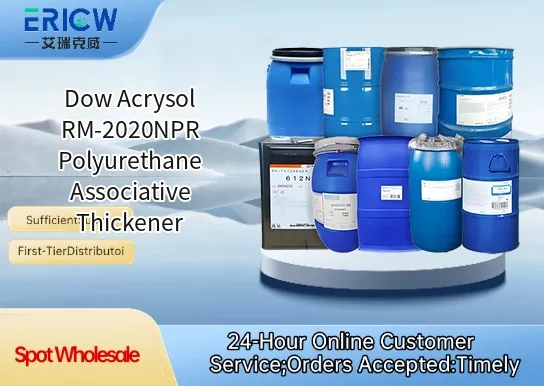
Delivers excellent rheology control in both low- and high-shear conditions for balanced application and sag resistance.
Provides outstanding compatibility with a broad range of waterborne systems, including acrylic, vinyl acetate, and styrene-acrylic emulsions.
Offers low VOC content and is APEO-free, supporting compliance with stringent environmental and regulatory requirements.
Delivers superior film integrity and clarity without compromising gloss or color development in architectural and industrial coatings.
Enables efficient thickening at low dosage levels, improving formulation efficiency and cost-effectiveness.
Architectural interior and exterior latex paints.
Industrial maintenance coatings for metal and concrete substrates.
Wood finishes and clear topcoats requiring high clarity and flow leveling.
Waterborne primers and undercoats with demanding viscosity and stability requirements.
Specialty decorative coatings, including texture paints and faux finishes.
| Chemical Type | Polyurethane associative thickener (HEUR) |
| Product Form | Aqueous dispersion |
| Appearance | Off-white to light tan viscous liquid |
| pH (1% aqueous solution) | 6.5 – 8.5 |
| Active Content (wt%) | 25 – 27% |
| Viscosity (Brookfield, spindle #3, 20 rpm, 25°C) | 1,500 – 4,000 cP |
| Freeze-Thaw Stability | Pass (3 cycles at -15°C / 23°C) |
| Primary Applications | Waterborne architectural and industrial coatings |
Q1: What is the primary thickening mechanism of RM-2020NPR?
A: RM-2020NPR functions as an associative thickener, relying on hydrophobic interactions between its polyurethane backbone and other hydrophobic sites in the formulation—such as surfactants, polymer particles, or pigment surfaces—to form a transient, reversible network that imparts viscosity and rheological control.
Q2: How does RM-2020NPR differ from cellulosic or acrylic thickeners in performance?
A: Unlike non-associative thickeners, RM-2020NPR delivers superior shear-thinning behavior, improved spatter resistance, and enhanced leveling—especially in high-solids, low-VOC architectural coatings. It also provides better compatibility with surfactants and co-thickeners, and less sensitivity to electrolytes compared to many acrylic associates.
Q3: Is RM-2020NPR suitable for use in both waterborne architectural and industrial coatings?
A: Yes—RM-2020NPR is widely used in interior and exterior architectural paints, as well as industrial maintenance coatings, where balanced viscosity build, sag resistance, and brush/roller application properties are required. Its performance remains robust across a range of pH levels and common formulation components.
Q4: What is the recommended addition method for optimal performance?
A: RM-2020NPR is typically added during the let-down stage, after pigments and primary binders are dispersed. It should be diluted with water or compatible solvent prior to incorporation and mixed under moderate shear to ensure uniform distribution and full activation of associative structures.
Q5: Does RM-2020NPR require pH adjustment for activation or stability?
A: RM-2020NPR is not pH-sensitive like some acrylic thickeners and performs effectively across a broad pH range (typically pH 6–10). However, extreme pH values outside this range may affect long-term storage stability or rheological development and should be evaluated case by case.
Contact With Us:
E-mail: wangxingqiang@ericwchem.com
Have a Questions? Call Us:
Add:
Building A1, Jiete Industrial Park, Huangpu District, Guangzhou City, Guangdong Province, China