English
 Español
 tiếng việt
 русский
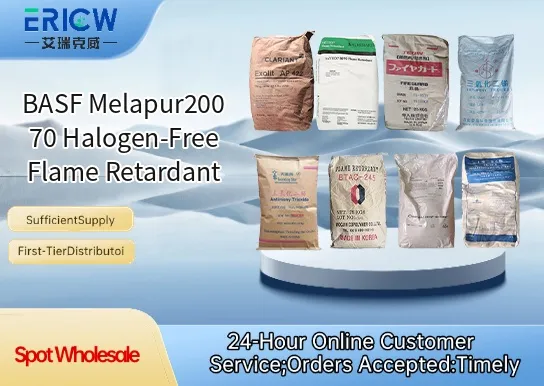
Phosphorus-based, halogen-free formulation meeting stringent environmental and regulatory requirements (e.g., RoHS, REACH).
Excellent thermal stability up to 300 °C, enabling compatibility with high-processing-temperature polymers.
Good hydrolytic stability and low volatility, supporting long-term performance in demanding applications.
Efficient flame retardancy in polyamide 6 and polyamide 66, achieving UL 94 V-0 rating at typical loadings of 15–20 wt%.
Low smoke generation and reduced toxic gas emission during combustion compared to brominated alternatives.
Electrical and electronic components requiring UL 94 V-0 compliance (e.g., connectors, housings, circuit breakers).
Automotive interior parts including under-hood components and cabin modules where low smoke and halogen-free status are critical.
Industrial machinery housings exposed to elevated temperatures and fire-safety regulations.
Consumer appliance casings and power tools demanding sustainable flame-retardant solutions.
LED lighting fixtures requiring non-corrosive, halogen-free flame retardancy for optical clarity and longevity.
| Chemical Type | Organophosphorus compound (melamine polyphosphate derivative) |
| Product Form | Free-flowing white granules |
| Appearance | White to off-white granular solid |
| Density (23 °C) | ~1.8 g/cm³ |
| Decomposition Onset Temperature | ≥280 °C (TGA, 10 K/min, air) |
| Moisture Content (max) | 0.3 wt% |
| pH (10 wt% aqueous suspension) | 6.0–7.5 |
| Key Regulatory Compliance | REACH registered; RoHS compliant; no SVHCs above threshold |
Q1: What types of polymers is Melapur200 70 compatible with?
A: Melapur200 70 is primarily designed for use in polyolefins such as polypropylene (PP) and polyethylene (PE), including both homopolymers and copolymers. It may also be incorporated into certain engineering thermoplastics where halogen-free flame retardancy is required, though compatibility and dispersion should be verified during formulation development.
Q2: How does Melapur200 70 achieve flame retardancy without halogens?
A: Melapur200 70 functions through an intumescent mechanism — upon exposure to heat, it promotes the formation of a protective, carbon-rich char layer on the polymer surface. This char insulates the underlying material, slows down heat transfer, and reduces the release of flammable volatiles, thereby suppressing flame propagation.
Q3: Does Melapur200 70 affect the mechanical properties or processability of the final compound?
A: When properly dispersed and compounded, Melapur200 70 typically delivers good balance between flame performance and mechanical integrity. It generally maintains acceptable tensile strength and impact resistance in PP-based systems. However, dosage and processing conditions — especially shear history and melt temperature — can influence viscosity and final part properties, so optimization is recommended for each application.
Q4: Is Melapur200 70 suitable for applications requiring regulatory compliance for food contact or low-smoke emissions?
A: Melapur200 70 is formulated to be halogen-free and produces significantly lower smoke and corrosive gases compared to halogenated alternatives. While it is not inherently approved for food-contact applications, its composition supports evaluation against relevant regional requirements when used in appropriate matrices and concentrations. Regulatory suitability must be confirmed case by case, considering full formulation and intended use conditions.
Contact With Us:
E-mail: wangxingqiang@ericwchem.com
Have a Questions? Call Us:
Add:
Building A1, Jiete Industrial Park, Huangpu District, Guangzhou City, Guangdong Province, China