English
 Español
 tiếng việt
 русский
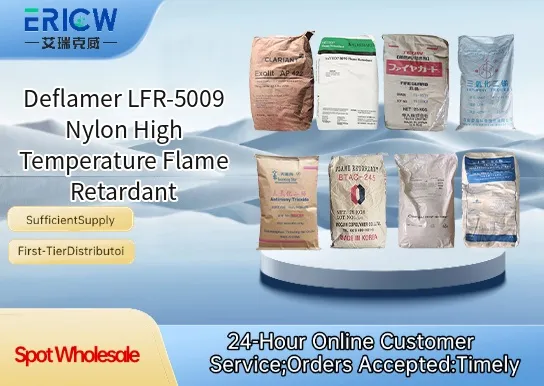
Exceptional thermal stability—retains flame-retardant efficacy up to 300 °C processing temperatures.
Halogen-free formulation—meets stringent RoHS and REACH compliance requirements.
Excellent dispersion in nylon 6 and nylon 66 matrices—ensures uniform flame resistance without compromising mechanical properties.
Low loading requirement (8–12 wt%) for UL94 V-0 rating at 1.6 mm thickness.
Minimal impact on color and clarity—ideal for light-colored and transparent nylon applications.
Automotive under-hood components requiring high-heat flame resistance.
Electrical connectors and housings for industrial control systems.
3D printing filaments based on flame-retardant nylon for functional prototyping.
Consumer electronics enclosures exposed to elevated operating temperatures.
Aerospace interior trim parts meeting FAR 25.853 smoke and toxicity criteria.
| Chemical Type | Phosphorus-nitrogen synergistic intumescent system |
| Product Form | Free-flowing granular powder |
| Appearance | Off-white to pale yellow granules |
| Primary Applications | Flame retardancy for polyamide 6, 66, and high-temperature nylons |
| Key Features | Halogen-free, thermally stable, low-migration, UL94 V-0 compliant |
| Benefits | Enhanced processability, reduced corrosivity, improved long-term aging performance |
| Density (23 °C) | 1.42–1.48 g/cm³ |
| Moisture Content (max) | 0.2 wt% |
Q1: What nylon grades is Deflamer LFR-5009 compatible with?
A: Deflamer LFR-5009 is specifically engineered for high-temperature processing of polyamide 6, polyamide 66, and their copolymers. It demonstrates excellent compatibility and dispersion in both unfilled and glass-fiber-reinforced nylon systems.
Q2: How does LFR-5009 perform under extended high-temperature processing conditions?
A: LFR-5009 exhibits superior thermal stability during melt compounding and injection molding at temperatures up to 310°C. Its molecular design minimizes degradation, volatilization, and discoloration—supporting consistent flame-retardant performance and mechanical property retention in demanding processing environments.
Q3: Does LFR-5009 affect the mechanical properties of nylon compounds?
A: When properly compounded, LFR-5009 delivers balanced flame retardancy with minimal impact on tensile strength, impact resistance, and flexural modulus. It is formulated to preserve the inherent toughness and dimensional stability of high-performance nylon systems.
Q4: What is the typical dosage range for achieving UL94 V-0 rating in thin-wall nylon parts?
A: Dosage depends on formulation requirements—including base resin type, filler content, and part geometry—but LFR-5009 is typically used at low concentrations to achieve UL94 V-0 at 1.6 mm. In most standard nylon 66/GF30 systems, effective loading generally ranges from 0.1% to 2% by weight.
Contact With Us:
E-mail: wangxingqiang@ericwchem.com
Have a Questions? Call Us:
Add:
Building A1, Jiete Industrial Park, Huangpu District, Guangzhou City, Guangdong Province, China