English
 Español
 tiếng việt
 русский
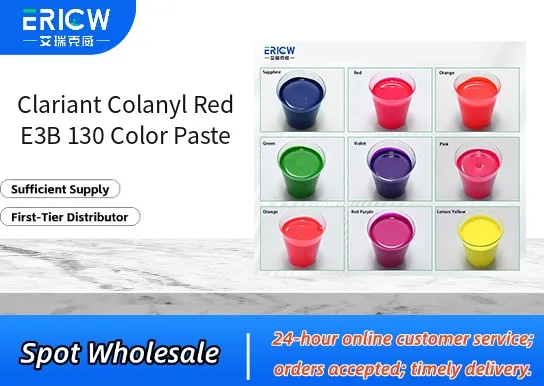
High chroma red shade with excellent batch-to-batch color consistency.
Optimized for low-viscosity, easy dispersion in water-based and solvent-based systems.
Good lightfastness and thermal stability up to 160 °C during processing.
Compliant with major global regulatory frameworks including REACH and RoHS.
Free of heavy metals, APEOs, and halogenated solvents.
Architectural coatings (interior/exterior wall paints).
Industrial maintenance coatings (metal primers and topcoats).
Wood finishes (stains, lacquers, and clear coats).
Plastic coloration for extrusion and injection molding (PVC, ABS, PS).
Printing inks for packaging and decorative applications.
| Chemical Type | Organic pigment dispersion (Red 170-based) |
| Product Form | Liquid color paste |
| Appearance | Viscous, homogeneous red paste |
| Primary Applications | Water-based and solvent-based coatings, plastics, inks |
| Key Features | High tinctorial strength, excellent rheology control |
| Benefits | Reduced dosing, simplified formulation, improved color development |
| VOC Content | Low-VOC compliant (< 50 g/L) |
| Storage Stability | 12 months at 5–30 °C in original sealed container |
Q1: What types of polymer systems is Colanyl Red E3B 130 compatible with?
A: Colanyl Red E3B 130 is formulated for use in a broad range of thermoplastic polymers, including polyolefins (PP, PE), ABS, PS, and certain engineering plastics. Compatibility should always be verified under actual processing conditions due to variations in resin grade, additives, and thermal history.
Q2: How stable is this color paste during high-temperature processing?
A: Colanyl Red E3B 130 exhibits good thermal stability suitable for standard melt-processing conditions in polyolefins and styrenics. It is not recommended for prolonged exposure above 260 °C or for applications requiring extreme heat resistance, such as high-temperature engineering thermoplastics processed above 280 °C.
Q3: Is this product suitable for food-contact applications?
A: Colanyl Red E3B 130 is designed for general industrial applications and is not pre-qualified for direct food-contact use. For regulated end uses, formulation-level compliance must be assessed by the compounder or end-user in accordance with applicable regional food-contact legislation and intended migration scenarios.
Q4: What is the typical dosage range for achieving full opacity or strong red shades?
A: Dosage depends on the base polymer, desired shade intensity, and required opacity. In most polyolefin applications, effective coloring typically ranges from 0.1% to 2% by weight. Lower concentrations are often sufficient for pastel tones, while higher loadings may be needed for deep, opaque reds — always confirm dispersion quality and color consistency via trial compounding.
Contact With Us:
E-mail: wangxingqiang@ericwchem.com
Have a Questions? Call Us:
Add:
Building A1, Jiete Industrial Park, Huangpu District, Guangzhou City, Guangdong Province, China