English
 Español
 tiếng việt
 русский
High reactivity with hydroxyl-functional resins, enabling efficient crosslinking at moderate cure temperatures.
Excellent compatibility with acrylic, polyester, and alkyd resin systems.
Low formaldehyde emission profile compared to conventional melamine-formaldehyde resins.
Good storage stability in solvent-based formulations when properly inhibited.
Delivers superior hardness, chemical resistance, and gloss retention in cured coatings.
Automotive OEM and refinish topcoats.
Industrial coil coatings for metal substrates.
General-purpose appliance and furniture coatings.
Can and closure coatings requiring FDA-compliant cure performance.
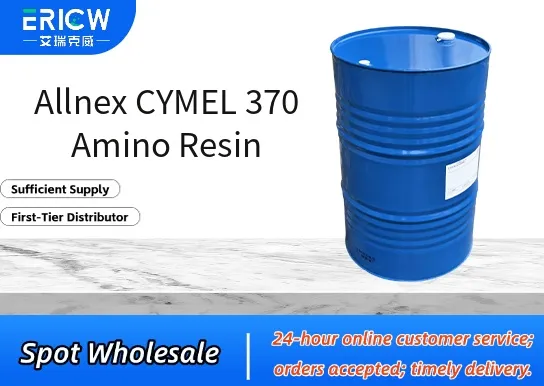
| Chemical Type | Melamine-formaldehyde crosslinker (partially alkylated) |
| Product Form | Liquid |
| Appearance | Clear, water-white to pale yellow liquid |
| Non-Volatile Content | 98–100 wt% (as received) |
| Viscosity (25°C) | 100–300 mPa·s |
| Density (25°C) | 1.20–1.24 g/cm³ |
| Solvent | n-Butanol |
| Primary Applications | Thermosetting coatings for metal and wood substrates |
Q1: What is the primary function of CYMEL 370 in coating formulations?
A: CYMEL 370 acts as a highly reactive crosslinking agent for hydroxyl- and carbamate-functional resins, enabling the formation of durable, thermoset networks upon thermal curing. It contributes to improved hardness, chemical resistance, and gloss retention in final coatings.
Q2: Is CYMEL 370 suitable for low-bake or ambient-cure systems?
A: CYMEL 370 is designed for thermal cure applications, typically requiring baking temperatures above 120 °C. It is not formulated for true ambient-cure performance; however, it may be used in moderate-bake systems when combined with appropriate acid catalysts and resin partners.
Q3: How should CYMEL 370 be stored to maintain stability?
A: Store in tightly sealed original containers at temperatures between 5 °C and 30 °C, away from moisture, strong acids, and direct sunlight. Prolonged exposure to high humidity or elevated temperatures may lead to premature condensation or viscosity increase.
Q4: Can CYMEL 370 be used in waterborne coating systems?
A: Yes — CYMEL 370 is compatible with many waterborne hydroxyl-functional acrylics and polyurethane dispersions, provided formulation pH is carefully controlled and co-solvents are selected to ensure homogeneity and shelf stability.
Q5: What catalysts are commonly recommended for use with CYMEL 370?
A: Weak organic acids such as p-toluenesulfonic acid (p-TSA), dinonylnaphthalene disulfonic acid (DNDSSA), or blocked acid catalysts are frequently employed to accelerate cure without compromising pot life or film appearance.
Contact With Us:
E-mail: wangxingqiang@ericwchem.com
Have a Questions? Call Us:
Add:
Building A1, Jiete Industrial Park, Huangpu District, Guangzhou City, Guangdong Province, China