English
 Español
 tiếng việt
 русский
Excellent abrasion resistance for extended service life in demanding mechanical environments.
Outstanding elasticity and recovery performance across a wide temperature range (–40 °C to 80 °C).
Good processability via injection molding and extrusion without requiring pre-drying under standard conditions.
High transparency and clarity suitable for aesthetic and optical applications.
Low extractables and compliance with FDA 21 CFR §177.2600 for indirect food contact applications.
Transparent protective films for electronics and touchscreens.
Soft-touch overmolded grips for power tools and medical handheld devices.
Seals and gaskets requiring dimensional stability and low compression set.
Flexible tubing for pneumatic and fluid handling systems.
Consumer goods components including watch bands, sportswear accessories, and eyewear frames.
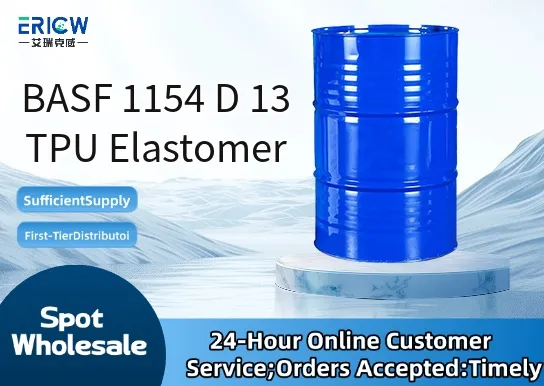
| Chemical Type | Aliphatic polyester-based thermoplastic polyurethane (TPU) |
| Product Form | Pellets |
| Appearance | Translucent, natural-colored granules |
| Shore A Hardness (ISO 868) | 94 ± 2 |
| Melt Flow Index (ISO 1133, 210 °C/10 kg) | 12–16 g/10 min |
| Density (ISO 1183) | 1.18–1.20 g/cm³ |
| Primary Applications | Transparent elastomeric parts, soft-touch overmolding, flexible seals |
| Key Features | Clarity, elasticity, abrasion resistance, process stability |
Q1: What are the key processing advantages of BASF 1154 D 13 compared to conventional TPU grades?
A: BASF 1154 D 13 is engineered for enhanced melt processability—exhibiting lower melt viscosity and improved flow stability during extrusion and injection molding. This enables smoother handling in high-speed production lines and better surface replication in complex mold geometries, especially for thin-walled or highly detailed parts.
Q2: Is this grade suitable for applications requiring long-term flexibility at low temperatures?
A: Yes—BASF 1154 D 13 delivers excellent low-temperature flexibility due to its aliphatic polyester-based chemistry and balanced hard-segment content. It maintains elastomeric performance down to approximately −30 °C without significant stiffening or cracking, making it well-suited for outdoor, automotive, and wearable applications exposed to cold environments.
Q3: How does BASF 1154 D 13 perform in terms of hydrolytic stability?
A: As a polyester-type TPU, it offers good resistance to hydrolysis under typical indoor conditions and moderate humidity. For extended service life in warm, humid environments or continuous water contact, stabilization additives or post-processing drying protocols are recommended to maintain mechanical integrity over time.
Q4: Can BASF 1154 D 13 be used in direct-contact applications with skin or soft-touch surfaces?
A: Yes—its smooth surface finish, low extractables profile, and absence of plasticizers or heavy metals make it frequently selected for consumer-facing components such as grips, seals, and wearable device housings. Compatibility with skin-contact requirements should be verified through final product testing under intended use conditions.
Contact With Us:
E-mail: wangxingqiang@ericwchem.com
Have a Questions? Call Us:
Add:
Building A1, Jiete Industrial Park, Huangpu District, Guangzhou City, Guangdong Province, China