English
 Español
 tiếng việt
 русский
High reactivity with amine and anhydride curing agents for rapid gelation and short cycle times.
Excellent adhesion to metals, composites, and treated plastics under ambient and elevated temperature conditions.
Low viscosity (12,000–15,000 cP at 25°C) enabling easy processing, impregnation, and air release in casting and potting applications.
Superior electrical insulation properties with high dielectric strength and volume resistivity.
Good chemical resistance to diluted acids, alkalis, and solvents after full cure.
Electrical encapsulation and potting of transformers, reactors, and high-voltage insulators.
Structural bonding in automotive electronics and power module assemblies.
Casting and laminating for medium-voltage switchgear components.
Matrix resin in glass-fiber reinforced composites for industrial enclosures.
Underfill and conformal coating for PCB protection in harsh-environment electronics.
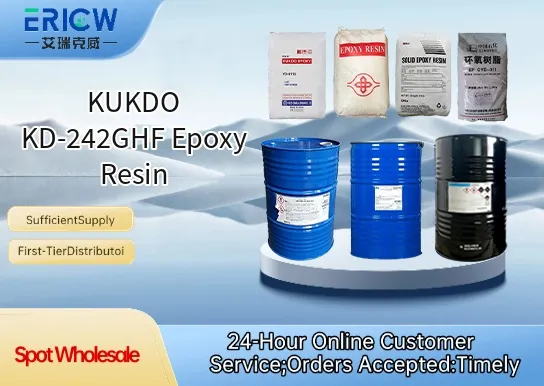
| Chemical Type | Bisphenol-F based liquid epoxy resin |
| Product Form | Clear to pale yellow viscous liquid |
| Appearance | Homogeneous, transparent, free from gels or suspended particles |
| Epoxy Equivalent Weight (EEW) | 178–186 g/eq |
| Viscosity (25°C) | 12,000–15,000 cP |
| Chloride Content | ≤ 800 ppm |
| Softening Point | Not applicable (liquid at room temperature) |
| Primary Applications | Electrical insulation, potting, casting, and structural bonding |
Q1: What is the primary functional role of KD-242GHF in epoxy formulations?
A: KD-242GHF is a glycidyl ether-modified bisphenol-A epoxy resin designed to enhance flexibility, impact resistance, and adhesion while maintaining good thermal stability and chemical resistance. It is commonly used as a reactive diluent or toughness modifier in structural adhesives, protective coatings, and composite matrices.
Q2: Is KD-242GHF compatible with standard amine and anhydride curing agents?
A: Yes, KD-242GHF exhibits broad compatibility with common aliphatic and aromatic amines, as well as cyclic anhydrides. Its reduced viscosity compared to standard DGEBA resins facilitates easier mixing and improved wetting of fillers or reinforcements without compromising reactivity.
Q3: How does KD-242GHF differ from conventional liquid epoxy resins like DGEBA in terms of processing behavior?
A: KD-242GHF offers lower melt viscosity and improved flow characteristics at ambient and elevated temperatures, supporting better filler incorporation and reduced entrapped air in casting or potting applications. Its modified structure also contributes to slower exotherm development during cure, which helps minimize internal stress in thick-section parts.
Q4: Can KD-242GHF be used in applications requiring FDA-compliant or food-contact-safe cured systems?
A: KD-242GHF itself is not pre-certified for food contact; however, it may be incorporated into finished formulations that meet relevant regulatory requirements—subject to full system validation, including selection of compliant hardeners, additives, and post-cure conditions. End-use compliance must be verified by the formulator.
Contact With Us:
E-mail: wangxingqiang@ericwchem.com
Have a Questions? Call Us:
Add:
Building A1, Jiete Industrial Park, Huangpu District, Guangzhou City, Guangdong Province, China