English
 Español
 tiếng việt
 русский
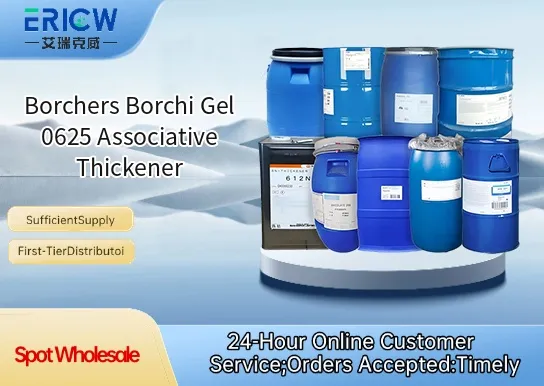
Highly efficient associative thickening in low-shear and high-shear conditions.
Excellent compatibility with anionic, nonionic, and amphoteric surfactants.
Provides outstanding viscosity stability across wide pH range (pH 4–12).
Delivers superior sag resistance and brush/roller application performance.
Low foaming profile suitable for high-speed industrial coating processes.
Architectural waterborne paints and coatings.
Industrial maintenance coatings and protective finishes.
Textile printing pastes and pigment dispersions.
Carpet and floor care formulations.
Agrochemical suspension concentrates (SC) and adjuvant systems.
| Chemical Type | Hydrophobically modified ethoxylated urethane (HEUR) |
| Product Form | Clear to slightly hazy viscous liquid |
| Appearance | Colorless to pale yellow liquid |
| pH (1% aqueous solution) | 6.0–8.0 |
| Active Content | 30.0–32.0 wt% |
| Viscosity (25°C, Brookfield RVT, spindle #3, 20 rpm) | 15,000–25,000 mPa·s |
| Solubility | Water-miscible; forms clear solutions in water at recommended dosage |
| Storage Stability | Stable for ≥12 months at 5–30°C in original sealed container |
Q1: What type of rheology does Borchi Gel 0625 provide in aqueous systems?
A: Borchi Gel 0625 is an associative thickener that delivers pronounced shear-thinning behavior and excellent low-shear viscosity build, supporting good sag resistance and leveling in coatings and construction formulations.
Q2: How does Borchi Gel 0625 differ from cellulosic or acrylic thickeners?
A: Unlike non-associative thickeners, Borchi Gel 0625 functions via hydrophobic association in water, offering superior compatibility with surfactants and co-solvents, reduced sensitivity to electrolytes, and improved film formation without compromising clarity in transparent systems.
Q3: Is Borchi Gel 0625 suitable for high-pH or alkaline formulations?
A: Yes — Borchi Gel 0625 exhibits good stability across a broad pH range, including alkaline environments commonly encountered in architectural paints and cementitious mortars, without significant viscosity loss or phase separation.
Q4: Can Borchi Gel 0625 be used in combination with other rheology modifiers?
A: Yes — it is frequently combined with inorganic thickeners (e.g., bentonite) or non-ionic polymers to achieve synergistic rheological profiles, though compatibility testing is recommended to avoid antagonistic interactions or viscosity suppression.
Q5: What are the typical handling and addition recommendations for Borchi Gel 0625?
A: It is generally added during the let-down stage under moderate agitation; pre-dilution in water or compatible solvent may aid dispersion. Final dosage depends on formulation requirements but typically ranges from 0.1% to 2% by weight of the total system.
Contact With Us:
E-mail: wangxingqiang@ericwchem.com
Have a Questions? Call Us:
Add:
Building A1, Jiete Industrial Park, Huangpu District, Guangzhou City, Guangdong Province, China