English
 Español
 tiếng việt
 русский
Highly selective for low-temperature ammonia synthesis under moderate pressure conditions.
Robust thermal and mechanical stability, ensuring extended catalyst lifetime in continuous operation.
Optimized nickel–promoter formulation enabling rapid start-up and stable performance across variable feed gas compositions.
Low methane formation tendency, improving hydrogen utilization efficiency and reducing purge gas requirements.
Sulfur-tolerant design with enhanced resistance to common trace poisons in syngas streams.
Small-to-medium-scale ammonia production plants using conventional or modular synthesis loops.
On-site ammonia generation for fertilizer blending units and agricultural cooperatives.
Ammonia synthesis in distributed chemical manufacturing facilities with limited infrastructure.
Hydrogen-rich syngas upgrading where low-pressure operation is preferred for energy efficiency.
Backup or swing catalyst systems requiring fast commissioning and reliable transient performance.
| Chemical Type | Nickel-based promoted catalyst with alkaline earth and rare earth promoters |
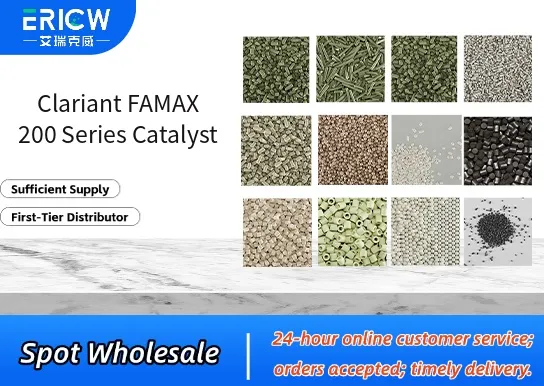
| Product Form | Extruded cylindrical pellets (3–5 mm diameter, 4–10 mm length) |
| Appearance | Grayish-black, free-flowing granular solid |
| Primary Applications | Low-to-moderate pressure ammonia synthesis (80–150 bar), 380–450 °C |
| Key Features | High activity at lower temperatures, sulfur resilience, low coking tendency |
| Benefits | Reduced energy consumption, longer cycle life, simplified process control |
| Storage Requirement | Keep sealed under dry inert atmosphere; protect from moisture and air exposure |
| Packaging | Hermetically sealed steel drums (150 kg net) or bulk containers upon request |
Q1: What is the primary function of the FAMAX 200 Series in polymer processing?
A: The FAMAX 200 Series is a family of highly active amine-based catalysts designed to promote efficient urethane bond formation in polyurethane systems, particularly during foaming and elastomer production. It supports rapid gelation and controlled rise profiles while maintaining good flow and cell structure development.
Q2: Is the FAMAX 200 Series suitable for both flexible and rigid PU foam applications?
A: Yes — the series offers formulation flexibility across a broad range of polyurethane applications, including flexible slabstock, molded foams, and certain rigid insulation systems. Performance characteristics such as reactivity balance and compatibility with other catalysts allow tailoring to specific foam density, hardness, and cure requirements.
Q3: How does FAMAX 200 compare to traditional tertiary amine catalysts in terms of odor and volatility?
A: FAMAX 200 catalysts are engineered to offer lower volatility and reduced residual odor compared to many conventional low-molecular-weight tertiary amines. This contributes to improved workplace handling and supports end-use requirements where low-emission profiles are valued.
Q4: Can FAMAX 200 be used in combination with other catalysts?
A: Yes — it is commonly used in synergistic blends with other catalysts (e.g., delayed-action amines or metal-based systems) to fine-tune reactivity, improve processing window, and achieve desired physical properties. Compatibility testing under actual formulation conditions is recommended to optimize performance.
Q5: What are typical handling and storage recommendations for FAMAX 200 products?
A: Store in original sealed containers at temperatures between 10–30 °C, protected from moisture and direct sunlight. Avoid prolonged exposure to air due to potential sensitivity to humidity. Use appropriate personal protective equipment (PPE), including gloves and eye protection, during handling.
Contact With Us:
E-mail: wangxingqiang@ericwchem.com
Have a Questions? Call Us:
Add:
Building A1, Jiete Industrial Park, Huangpu District, Guangzhou City, Guangdong Province, China