English
 Español
 tiếng việt
 русский
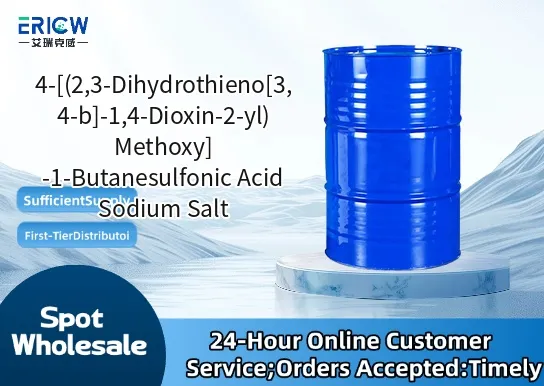
Highly water-soluble sodium salt form enabling rapid dissolution in aqueous processing environments.
Stable under ambient storage conditions with low hygroscopicity and minimal degradation over 24 months.
Contains a fused dihydrothienodioxin heterocycle that enhances electronic delocalization for conductive polymer applications.
Features a flexible butylenesulfonate linker providing optimal spacing between the conjugated core and ionic head group.
Manufactured under strict ISO 9001-certified processes with batch-to-batch reproducibility (RSD < 2.5% in HPLC assay).
Primary dopant and charge-balancing counterion in PEDOT:PSS formulations for transparent conductive films.
Stabilizing dispersant for aqueous nanocarbon suspensions (e.g., graphene oxide, carbon nanotubes) in printed electronics inks.
Electrolyte additive in quasi-solid-state supercapacitors to improve interfacial ion transport and electrode wettability.
Surface modifier for metal oxide nanoparticles (e.g., TiO₂, ITO) in photoelectrochemical device fabrication.
Functional co-monomer in sulfonated conductive copolymer synthesis for fuel cell membrane development.
| Chemical Type | Organic sulfonic acid sodium salt; conjugated heterocyclic surfactant |
| Product Form | Free-flowing white to off-white crystalline powder |
| Appearance | Free-flowing crystalline solid, no visible clumps or discoloration |
| Melting Point (Decomposition) | 228–232 °C (DSC, onset under N₂) |
| Primary Applications | Conductive polymer doping, aqueous nanomaterial dispersion, electroactive coatings |
| Key Features | High purity (>98.5% by HPLC), low residual solvents (<0.1% total), sulfate-free synthesis pathway |
| Benefits | Enhanced film conductivity vs. conventional PSS, reduced acidity-induced substrate corrosion, improved ink shelf life |
| Regulatory Compliance | REACH registered; not classified as SVHC; compliant with RoHS Directive 2011/65/EU |
| Common Compatible Systems | Suitability |
| PEDOT dispersion (aqueous) | Highly Recommended – Enables stable >12-month shelf life and consistent conductivity (≥1000 S/cm) |
| Water-based acrylic emulsion systems | Recommended – Effective dispersant without compromising film integrity or adhesion |
| PEG-400 / glycerol plasticized conductive inks | Suitable – Maintains viscosity stability and prevents phase separation at ≤5 wt% loading |
| Acid-catalyzed sol-gel precursors (e.g., TEOS/HCl) | Not Recommended – Risk of dioxin ring hydrolysis under strongly acidic conditions (pH < 2) |
Q1: What is the CAS Registry Number for this compound?
A: The CAS Number is 1127233-71-0 — verified for the sodium salt form with confirmed structural assignment via ¹H/¹³C NMR and HRMS.
Q2: What is the typical recommended usage concentration in PEDOT:PSS formulations?
A: Standard loading is 0.5–2.0 wt% relative to PEDOT:PSS solids; optimization at 1.2 wt% delivers peak conductivity and mechanical flexibility for flexible electronics substrates.
Q3: How does it compare to standard polystyrene sulfonate (PSS) in terms of thermal stability and migration resistance?
A: Exhibits superior thermal stability (T₅% = 225 °C vs. 195 °C for PSS) and significantly lower extractable fraction (<0.3% in 72-hr deionized water soak at 60 °C per ASTM D1290).
Q4: Is it suitable for food-contact or medical device applications?
A: Not currently approved for direct food contact (FDA 21 CFR) or implantable medical devices; intended for industrial R&D and electronic materials manufacturing only.
Q5: Does it require special handling for moisture or light sensitivity?
A: Store under inert atmosphere (N₂) in sealed aluminum-laminated pouches at 2–8 °C; protect from ambient humidity (>40% RH) and UV exposure to preserve sulfonate integrity and prevent dioxin ring oxidation.
Contact With Us:
E-mail: wangxingqiang@ericwchem.com
Have a Questions? Call Us:
Add:
Building A1, Jiete Industrial Park, Huangpu District, Guangzhou City, Guangdong Province, China