English
 Español
 tiếng việt
 русский
Excellent balance of soft-touch feel and mechanical strength for demanding overmolding applications.
Superior adhesion to polypropylene (PP) and polyethylene (PE) substrates without primer or surface treatment.
Good processability on standard injection molding and extrusion equipment with low melt viscosity and narrow processing window.
Enhanced weather resistance and UV stability suitable for outdoor-facing automotive and consumer components.
Compliant with RoHS and REACH regulations; free of phthalates, heavy metals, and halogenated flame retardants.
Automotive interior trim: door handles, armrests, and center console overlays.
Consumer electronics: soft-grip casings for power tools, remote controls, and handheld devices.
Household appliances: ergonomic grips for vacuum cleaners, kitchen appliances, and personal care devices.
Medical device housings requiring tactile feedback and chemical resistance to common disinfectants.
Industrial equipment: non-slip grips, seals, and protective overmolded covers for control panels and tooling.
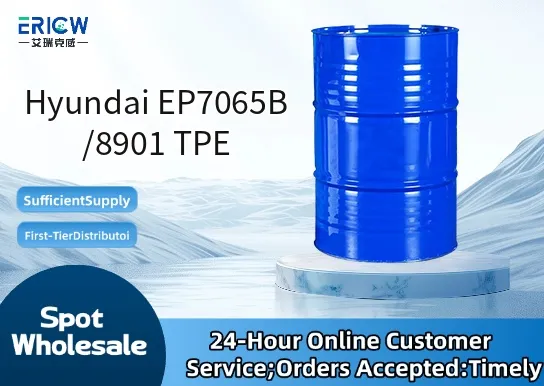
| Chemical Type | Thermoplastic Elastomer (TPE) – Styrenic Block Copolymer (SBC) based |
| Product Form | Pellets |
| Appearance | Translucent light amber granules |
| Hardness (Shore A) | 65 ± 3 |
| Melt Flow Rate (200°C/5 kg) | 18–22 g/10 min |
| Density | 0.92–0.94 g/cm³ |
| Primary Applications | Overmolding, soft-touch finishing, flexible functional parts |
| Key Features | PP/PE adhesion, low odor, recyclable, FDA-compliant for indirect food contact (per formulation) |
Q1: What is the primary application domain for Hyundai EP7065B/8901 TPE?
A: Hyundai EP7065B/8901 TPE is a thermoplastic elastomer specifically engineered for soft-touch overmolding and functional sealing applications in automotive interior components, consumer electronics housings, and medical device grips — where balanced elasticity, processability, and surface aesthetics are critical.
Q2: Is EP7065B/8901 compatible with common engineering thermoplastics like PP, ABS, or PC?
A: Yes, EP7065B/8901 exhibits strong adhesion to polypropylene (PP) and ABS substrates without requiring primers or surface treatment under standard two-shot injection molding conditions. Compatibility with polycarbonate (PC) may require process optimization and is typically evaluated case-by-case.
Q3: What processing methods are recommended for this TPE grade?
A: EP7065B/8901 is optimized for injection molding and two-component (2K) overmolding. It performs well on standard screw-type injection molding machines with moderate melt temperatures and short residence times. Extrusion is possible but less common and requires careful thermal management to preserve elasticity.
Q4: How does EP7065B/8901 perform under elevated temperature exposure?
A: This TPE maintains dimensional stability and tactile integrity up to approximately 70–80 °C during short-term service. Prolonged exposure above 85 °C may lead to gradual softening or compression set increase, so thermal design margins should be considered for continuous-use applications.
Contact With Us:
E-mail: wangxingqiang@ericwchem.com
Have a Questions? Call Us:
Add:
Building A1, Jiete Industrial Park, Huangpu District, Guangzhou City, Guangdong Province, China