English
 Español
 tiếng việt
 русский
Highly selective palladium-based heterogeneous catalyst for efficient C–C coupling reactions.
Thermally stable up to 200 °C, enabling robust performance in demanding continuous processes.
Low leaching profile ensures consistent catalytic activity and meets stringent regulatory requirements for pharmaceutical intermediates.
Engineered with controlled particle size distribution for optimal mass transfer and reactor scalability.
Compatible with standard industrial solvents including toluene, THF, and DMF without significant deactivation.
Pharmaceutical synthesis — Suzuki and Heck cross-coupling reactions for API building blocks.
Agrochemical manufacturing — selective aryl–aryl bond formation in active ingredient synthesis.
Electronic materials — preparation of conjugated organic semiconductors and OLED precursors.
Fine chemical production — high-yield coupling under mild conditions for complex molecule assembly.
Custom manufacturing services — supported catalyst format ideal for fixed-bed and flow reactor configurations.
| Chemical Type | Palladium on carbon-supported modified ligand system |
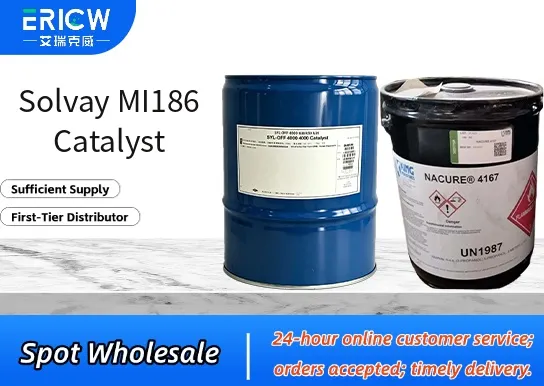
| Product Form | Free-flowing black granular solid |
| Appearance | Uniform dark gray to black granules |
| Palladium Content | 5.0 wt% ± 0.3 wt% |
| Primary Applications | Suzuki, Heck, and Stille cross-coupling reactions |
| Key Features | Low metal leaching, high thermal stability, reproducible batch-to-batch performance |
| Storage Conditions | Store under inert atmosphere at room temperature (15–25 °C) |
| Handling Precautions | Use in well-ventilated area; avoid contact with strong oxidizers or acids |
Q1: What is the primary application of Solvay MI186 Catalyst?
A: Solvay MI186 Catalyst is specifically designed to accelerate condensation-cure reactions in silicone elastomer systems, particularly for high-performance liquid silicone rubber (LSR) formulations used in medical, automotive, and precision molding applications.
Q2: Is Solvay MI186 Catalyst compatible with platinum-cure silicones?
A: No — MI186 is a tin-based catalyst formulated for condensation-cure silicones. It is incompatible with platinum-cure systems and may inhibit or poison platinum catalysts if cross-contaminated.
Q3: How should Solvay MI186 Catalyst be handled and stored?
A: Store in tightly sealed containers under dry, cool conditions away from moisture, strong oxidizing agents, and direct sunlight. Handle using appropriate personal protective equipment (PPE), as it is moisture-sensitive and may hydrolyze upon prolonged exposure to ambient humidity.
Q4: What is the typical dosage range for Solvay MI186 Catalyst in silicone formulations?
A: Dosage is formulation-dependent but generally ranges from 0.1% to 2% by weight relative to the base polymer. Optimal loading should be determined through small-scale trials to balance cure speed, pot life, and final physical properties.
Q5: Does Solvay MI186 Catalyst require activation or pre-mixing before use?
A: MI186 is supplied as a ready-to-use liquid catalyst and typically requires only uniform dispersion into the base silicone component. Pre-mixing with a carrier fluid or diluent may be employed to improve handling consistency, especially in automated meter-mix dispensing systems.
Contact With Us:
E-mail: wangxingqiang@ericwchem.com
Have a Questions? Call Us:
Add:
Building A1, Jiete Industrial Park, Huangpu District, Guangzhou City, Guangdong Province, China