English
 Español
 tiếng việt
 русский
High transparency and excellent UV stability for long-term outdoor performance.
Good melt flow characteristics enabling efficient extrusion and injection molding.
Excellent weather resistance and color retention without yellowing under prolonged exposure.
Compatible with common plasticizers and impact modifiers for formulation flexibility.
Low moisture absorption ensuring dimensional stability in humid environments.
Automotive exterior trim and lighting lenses.
Architectural glazing and transparent façade panels.
Medical device housings requiring optical clarity and sterilization compatibility.
Consumer electronics front panels and display covers.
Signage and illuminated advertising components.
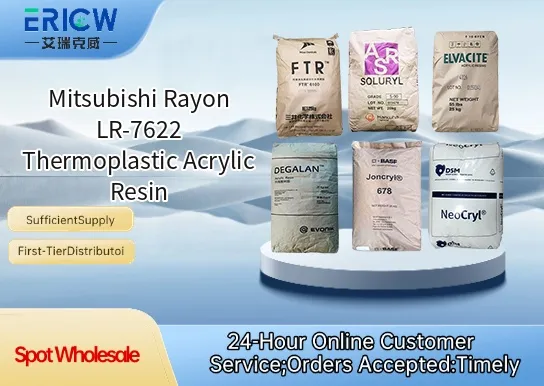
| Chemical Type | Thermoplastic acrylic copolymer |
| Product Form | Pellets |
| Appearance | White, translucent pellets |
| Primary Applications | Extrusion, injection molding, and thermoforming |
| Key Features | High clarity, UV resistance, thermal processability |
| Benefits | Outstanding optical properties, low haze, good surface hardness |
| Density (g/cm³) | 1.18–1.20 |
| Melt Flow Rate (230°C/3.8 kg) | 5–7 g/10 min |
Q1: What are the primary processing methods suitable for LR-7622?
A: LR-7622 is designed for thermoplastic processing techniques including extrusion, injection molding, and solution casting. Its low melt viscosity and good thermal stability support efficient melt processing, while its solubility in common organic solvents (e.g., methyl ethyl ketone, toluene, and ester-based systems) enables use in solvent-borne coating and ink formulations.
Q2: How does LR-7622 contribute to film performance in protective coatings?
A: LR-7622 enhances hardness, gloss retention, and weather resistance in thermoplastic acrylic coatings. It provides excellent clarity and UV stability, making it well-suited for high-durability topcoats on automotive trim, signage, and industrial finishes where long-term aesthetic integrity is critical.
Q3: Is LR-7622 compatible with other polymer resins or additives?
A: Yes — LR-7622 exhibits good compatibility with many thermoplastic resins such as cellulose acetate butyrate (CAB), polyvinyl butyral (PVB), and certain modified polyacrylates. It also blends well with common plasticizers, UV stabilizers, and pigment dispersants, though compatibility testing under end-use conditions is recommended to confirm stability and performance.
Q4: What safety and handling precautions should be observed during processing?
A: As a thermoplastic resin, LR-7622 should be processed below its decomposition temperature to avoid fume generation. Standard industrial hygiene practices apply: ensure adequate ventilation, especially when using solvent-based systems, and refer to the Safety Data Sheet (SDS) for specific handling, storage, and PPE guidance. Avoid prolonged skin contact and inhalation of dust or vapors.
Contact With Us:
E-mail: wangxingqiang@ericwchem.com
Have a Questions? Call Us:
Add:
Building A1, Jiete Industrial Park, Huangpu District, Guangzhou City, Guangdong Province, China