English
 Español
 tiếng việt
 русский
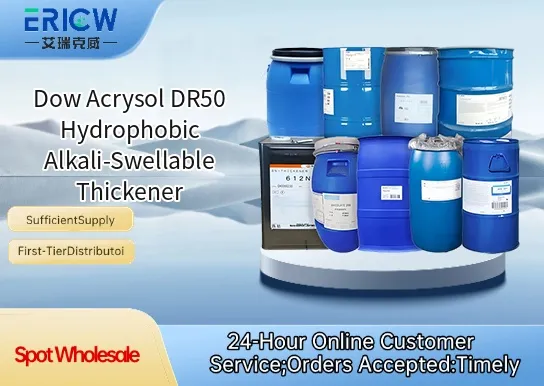
Delivers high mid-shear viscosity and excellent flow/leveling balance in waterborne coatings.
Provides superior resistance to water, surfactants, and electrolytes compared to conventional ASSF thickeners.
Offers robust rheology control across a broad pH range (pH 7.5–10.5) after neutralization.
Enables low-splatter, high-transfer efficiency spray application with reduced sagging on vertical surfaces.
Imparts outstanding freeze-thaw stability and long-term storage viscosity retention in architectural and industrial formulations.
Interior and exterior architectural latex paints.
Waterborne industrial maintenance coatings.
Low-VOC and zero-VOC decorative wall coatings.
Textured coatings and elastomeric finishes.
Stain-blocking primers and high-hiding basecoats.
| Chemical Type | Hydrophobically modified alkali-swellable emulsion (HASE) |
| Product Form | Aqueous dispersion |
| Appearance | White to off-white opaque liquid |
| pH (as supplied) | 2.5–4.0 |
| Non-Volatile Content (wt %) | 28.0–30.0 |
| Viscosity (Brookfield RVT, spindle #3, 20 rpm, 25°C) | 500–2,500 cP |
| Primary Applications | Architectural and industrial waterborne coatings |
| Key Features | Hydrophobic modification, alkali-activated thickening, shear-thinning behavior |
Q1: How does DR50 differ from conventional non-associative alkali-swellable thickeners (ASDs)?
A: DR50 is a hydrophobically modified alkali-swellable emulsion (HASE) polymer, offering enhanced rheology control—including improved sag resistance, better leveling, and superior film-building—compared to traditional non-associative ASDs. Its hydrophobic groups enable associative thickening in addition to ionic swelling, resulting in more robust viscosity response across shear rates and improved compatibility with surfactants and co-thickeners.
Q2: What pH range is required for optimal thickening performance?
A: DR50 requires alkaline activation to fully develop viscosity, typically at pH ≥ 8.0. Effective thickening is generally achieved between pH 8.5 and 10.5, with maximum viscosity development observed above pH 9.0. Performance may be reduced or delayed in formulations with insufficient alkaline reserve or rapid pH drift.
Q3: Can DR50 be used in combination with other rheology modifiers?
A: Yes, DR50 is commonly used synergistically with associative cellulose ethers (e.g., HEC, HMEC) or hydrophobically modified ethoxylated urethanes (HEURs) to balance low-shear viscosity, high-shear flow, and application properties. Compatibility should be verified in the final formulation, as interactions with certain surfactants or biocides may influence thickener efficiency.
Q4: Is DR50 suitable for low-VOC or zero-VOC architectural coatings?
A: Yes, DR50 is a water-based emulsion containing no added volatile organic compounds (VOCs) and is widely used in low-VOC and zero-VOC interior and exterior architectural coatings. It contributes no exempt solvents or VOC-exempt monomers, supporting compliance with major regional VOC regulations when formulated accordingly.
Contact With Us:
E-mail: wangxingqiang@ericwchem.com
Have a Questions? Call Us:
Add:
Building A1, Jiete Industrial Park, Huangpu District, Guangzhou City, Guangdong Province, China