English
 Español
 tiếng việt
 русский
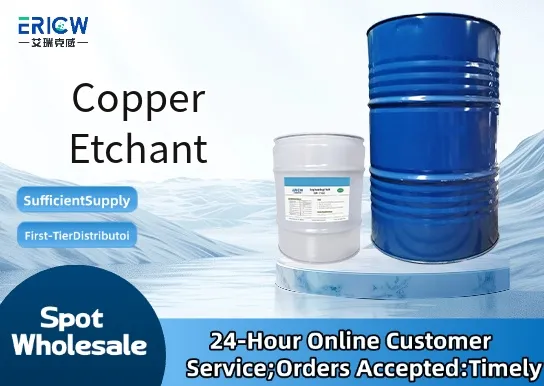
Highly selective etching of copper and copper alloys with minimal undercut or attack on underlying substrates such as nickel, titanium, or photoresist.
Stable, non-volatile formulation enabling consistent etch rates over extended bath life and multiple reuse cycles.
Low foaming and excellent wetting characteristics for uniform coverage on complex PCB geometries and fine-pitch features.
Environmentally optimized — chloride-free and low heavy-metal content, supporting RoHS-compliant manufacturing.
Rapid room-temperature operation (20–25°C), eliminating need for external heating systems and reducing energy consumption.
Inner-layer and outer-layer etching in rigid and flexible printed circuit board (PCB) fabrication.
Micromachining of copper-based MEMS components and sensor interconnects.
Pattern definition in high-frequency RF/microwave laminates (e.g., Rogers, Taconic) with copper cladding.
Etching of copper traces during semiconductor packaging substrate production (ABF, BT, and Ajinomoto films).
Repair and rework of copper circuitry in aerospace and defense electronics assemblies.
| Chemical Type | Oxidizing acid-based aqueous solution (non-halogenated) |
| Product Form | Liquid concentrate (ready-to-dilute) |
| Appearance | Clear, pale amber liquid |
| pH (1% w/w aqueous solution) | 1.8–2.2 at 25°C |
| Primary Applications | Copper layer removal in PCB, flex, and IC substrate manufacturing |
| Key Features | Photoresist-compatible, low corrosion to stainless steel tanks, no NOx fumes |
| Benefits | Reduced drag-out loss, predictable linear etch rate (~15–25 µm/min), easy waste treatment |
| Regulatory Compliance | RoHS 2015/863, REACH SVHC-free, non-Prop 65 listed |
| Common Compatible Systems | Suitability |
| Vertical Conveyor Etch Lines (e.g., SMT, Orbotech) | Highly Recommended – Optimized flow dynamics and spray pattern compatibility |
| Batch Immersion Tanks (PP or PVC-lined) | Recommended – Stable performance with standard agitation and temperature control |
| Automated Spray Etchers (e.g., Hitachi, Schmid) | Highly Recommended – Minimal nozzle clogging; validated for >500 hr continuous operation |
| Recirculating Filtration Systems with 5–10 µm bag filters | Suitable – Effective particulate removal without chemical degradation |
Q1: What is the CAS Registry Number for this Copper Etchant?
A: This is a proprietary multi-component formulation; individual CAS numbers are not assigned. Full ingredient disclosure per SDS (Section 3) is available upon request for qualified industrial users.
Q2: What is the recommended working concentration and typical etch rate?
A: Dilute 1:4 to 1:9 (v/v) with deionized water. At 25°C and 20–30 PSI spray pressure, nominal etch rate is 18–22 µm/min on 17–35 µm copper foil.
Q3: How does this etchant compare to traditional ferric chloride or ammonium persulfate solutions?
A: Unlike ferric chloride (corrosive, high sludge, poor selectivity) or ammonium persulfate (temperature-sensitive, rapid decomposition), this etchant offers superior process stability, lower maintenance, and higher copper loading capacity (>80 g/L before regeneration).
Q4: Does it comply with IPC-4552B for electroless nickel immersion gold (ENIG) pre-etch requirements?
A: Yes — validated for use prior to ENIG plating; demonstrates <0.5 nm Ni dissolution and no interfacial contamination per IPC-TM-650 2.3.25 testing.
Q5: Is copper migration or ion extraction observed on conformally coated assemblies after etching and rinsing?
A: No measurable copper ion migration occurs when final rinse conductivity is maintained ≤5 µS/cm (per IPC-A-600G Section 2.7.1); residual halide testing confirms <1 ppm Cl⁻ post-rinse.
Contact With Us:
E-mail: wangxingqiang@ericwchem.com
Have a Questions? Call Us:
Add:
Building A1, Jiete Industrial Park, Huangpu District, Guangzhou City, Guangdong Province, China