English
 Español
 tiếng việt
 русский
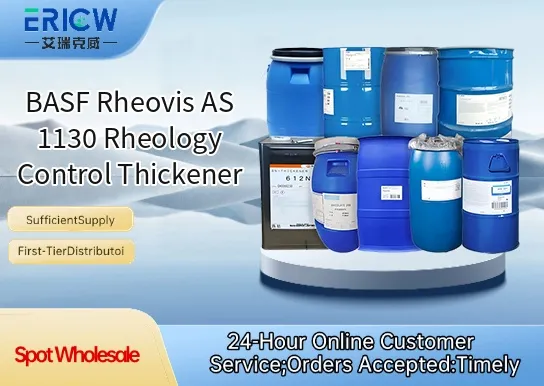
Non-ionic associative thickener based on polyurethane chemistry for efficient rheology modification in waterborne systems.
Delivers excellent viscosity build and sag resistance without compromising flow or leveling performance.
Compatible with a broad range of anionic and non-ionic surfactants, co-thickeners, and common paint additives.
Enables low-shear viscosity control ideal for spray application, brush/roller application, and storage stability.
Free from APEOs (alkylphenol ethoxylates) and VOC-compliant, supporting sustainable formulation requirements.
Architectural interior and exterior latex paints.
Industrial maintenance coatings including primers and topcoats.
Waterborne wood finishes and stains.
Emulsion-based adhesives and construction sealants.
Decorative wall coatings and textured finishes.
| Chemical Type | Non-ionic polyurethane associative thickener |
| Product Form | Liquid dispersion |
| Appearance | Opaque white to off-white viscous liquid |
| pH (1% aqueous solution) | 6.5 – 8.5 |
| Active Content (approx.) | 30 wt.% |
| Viscosity (Brookfield RVT, spindle #3, 20 rpm, 25 °C) | 1,500 – 4,500 mPa·s |
| Solubility | Water-dispersible; forms stable colloidal dispersions |
| Storage Stability | 12 months at 5–30 °C in original sealed container |
Q1: What is the primary function of Rheovis AS 1130 in formulations?
A: Rheovis AS 1130 is an associative thickener designed to provide efficient rheology control—particularly high-shear viscosity reduction and low-shear viscosity enhancement—in water-based systems. It helps stabilize pigments, prevent sagging in vertical applications, and improve brushability or spray performance.
Q2: In which types of coatings or formulations is Rheovis AS 1130 most commonly used?
A: It is widely applied in architectural paints (e.g., interior and exterior emulsion paints), industrial maintenance coatings, and water-based wood finishes where balanced flow, leveling, and anti-settling properties are required. It performs well in both acrylic and styrene-acrylic dispersions.
Q3: How is Rheovis AS 1130 typically incorporated into a formulation?
A: It is generally added during the let-down stage, either neat or pre-diluted with water or co-solvent, under moderate agitation. Premixing with water before addition helps ensure uniform dispersion and avoids localized overdosing. Compatibility with other additives should be verified in the final formulation matrix.
Q4: Does Rheovis AS 1130 offer resistance to microbial degradation?
A: Rheovis AS 1130 is not inherently biostable; like many non-ionic associative thickeners, it may be susceptible to enzymatic breakdown over time in unpreserved systems. Therefore, inclusion of an appropriate broad-spectrum preservative system is recommended for long-term storage stability.
Q5: Can Rheovis AS 1130 be used alongside other rheology modifiers?
A: Yes, it is often combined with cellulosic thickeners or inorganic thickeners (e.g., bentonite) to achieve synergistic rheological profiles—such as improved sag resistance without compromising spatter control. However, compatibility testing is essential, as interactions may affect viscosity development or storage stability.
Contact With Us:
E-mail: wangxingqiang@ericwchem.com
Have a Questions? Call Us:
Add:
Building A1, Jiete Industrial Park, Huangpu District, Guangzhou City, Guangdong Province, China