English
 Español
 tiếng việt
 русский
Excellent abrasion resistance for extended service life in demanding mechanical environments.
High tensile strength and elongation at break, enabling robust performance under dynamic stress.
Good low-temperature flexibility down to –30 °C, maintaining elasticity in cold-condition applications.
Outstanding oil and grease resistance, suitable for contact with hydrocarbon-based fluids.
Processable via standard thermoplastic techniques including extrusion, injection molding, and calendering.
Industrial hoses and tubing for hydraulic and pneumatic systems.
Wear-resistant conveyor belts and modular belt components.
Dynamic seals and gaskets in automotive and agricultural machinery.
Protective coatings and linings for material handling equipment.
Specialty footwear soles requiring high resilience and traction.
| Chemical Type | Thermoplastic Polyurethane (TPU), polyester-based |
| Product Form | Pellets |
| Appearance | Off-white to light tan, free-flowing granules |
| Primary Applications | Extruded profiles, molded parts, coated fabrics |
| Key Features | Abrasion resistance, oil resistance, mechanical toughness |
| Benefits | Reduced maintenance frequency, extended component lifetime, processing versatility |
| Density (ISO 1183) | Approx. 1.20 g/cm³ |
| Melt Flow Index (ISO 1133, 230 °C/5 kg) | Approx. 10–14 g/10 min |
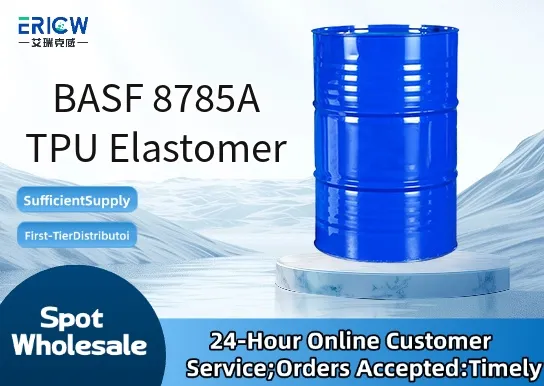
Q1: What is the primary application area for BASF 8785A TPU Elastomer?
A: BASF 8785A is a thermoplastic polyurethane elastomer specifically engineered for demanding extrusion and injection molding applications, with common use in high-performance automotive interior components, flexible industrial hoses, and durable consumer goods requiring excellent abrasion resistance and low-temperature flexibility.
Q2: How does BASF 8785A compare to conventional polyester-based TPUs in terms of hydrolytic stability?
A: As an ether-based TPU, BASF 8785A offers significantly improved resistance to hydrolysis compared to standard polyester TPUs—making it well-suited for applications exposed to moisture, humidity, or repeated thermal cycling without substantial loss of mechanical integrity.
Q3: Is BASF 8785A suitable for processing via two-component (2K) injection molding systems?
A: Yes, BASF 8785A is compatible with 2K injection molding processes when paired with appropriate substrate materials such as PP, PC, or ABS. It provides strong adhesion and interfacial bonding without requiring primers, provided that mold temperature, melt temperature, and residence time are optimized per standard TPU processing guidelines.
Q4: Does BASF 8785A require drying before processing?
A: Yes—like most hygroscopic TPUs, BASF 8785A must be thoroughly dried prior to melt processing to prevent surface defects, molecular weight degradation, and compromised mechanical properties. Recommended drying conditions typically involve 3–4 hours at 80–90 °C with dew point ≤ −40 °C.
Contact With Us:
E-mail: wangxingqiang@ericwchem.com
Have a Questions? Call Us:
Add:
Building A1, Jiete Industrial Park, Huangpu District, Guangzhou City, Guangdong Province, China