English
 Español
 tiếng việt
 русский
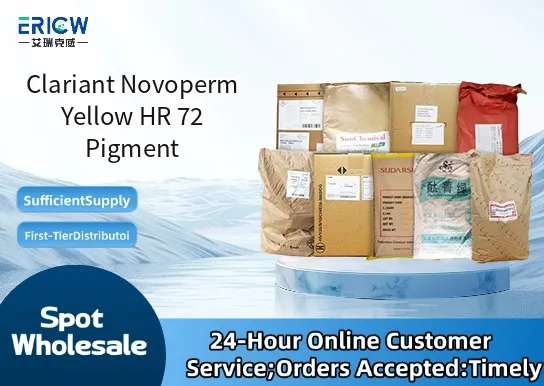
High chroma and excellent lightfastness in demanding outdoor applications.
Outstanding thermal stability suitable for high-temperature processing up to 280 °C.
Good dispersibility in both solvent-based and water-based systems.
Excellent resistance to migration and blooming in plastic and ink formulations.
Compliant with major global regulatory frameworks including REACH and RoHS.
Automotive coatings requiring long-term color retention and weather resistance.
Polyolefin (PP, PE) and PVC masterbatches for extrusion and injection molding.
Gravure and flexographic inks for packaging films and labels.
Industrial coil coatings exposed to UV and chemical environments.
Engineering plastics used in outdoor consumer electronics housings.
| Chemical Type | Organic Pigment – Diarylide Yellow (Pigment Yellow 12) |
| Product Form | Fine powder |
| Appearance | Bright greenish-yellow powder |
| Primary Applications | Plastics, coatings, inks |
| Key Features | High heat stability, low volatility, good opacity |
| Benefits | Consistent batch-to-batch color, minimal filter clogging in ink systems |
| Recommended Dispersing Media | Alkyd resins, acrylics, polyolefin waxes, polyester polyols |
| Storage Conditions | Store in cool, dry place; protect from moisture and direct sunlight |
Q1: What is the primary application field for Novoperm Yellow HR 72?
A: Novoperm Yellow HR 72 is primarily used in high-performance industrial coatings, automotive refinish systems, and premium plastics applications where excellent lightfastness, thermal stability, and color strength are required.
Q2: Is this pigment suitable for use in food-contact plastics?
A: Novoperm Yellow HR 72 is not approved for direct food-contact applications under major global regulatory frameworks. It is intended for non-food-contact industrial and decorative uses; consult Clariant’s regulatory documentation for specific compliance status per region and substrate.
Q3: How does Novoperm Yellow HR 72 compare to other yellow pigments in terms of heat stability?
A: This pigment exhibits very good thermal stability, typically withstanding processing temperatures up to 280–300 °C for short durations in polyolefins and engineering thermoplastics—making it more robust than many conventional diarylide yellows but less stable than inorganic yellow oxides.
Q4: What dispersion methods are recommended for optimal performance?
A: For best results, high-shear dispersion using suitable dispersants or surfactants is recommended—especially in solvent-borne coatings and polymer melts. Pre-dispersed paste or masterbatch forms are also widely used to ensure uniform distribution and maximize coloristic properties.
Q5: Can Novoperm Yellow HR 72 be used in water-based systems?
A: Yes, it can be formulated into water-based systems such as architectural paints and industrial waterborne coatings, provided appropriate surface treatment and stabilization technologies are applied to ensure colloidal stability and prevent flocculation.
Contact With Us:
E-mail: wangxingqiang@ericwchem.com
Have a Questions? Call Us:
Add:
Building A1, Jiete Industrial Park, Huangpu District, Guangzhou City, Guangdong Province, China