English
 Español
 tiếng việt
 русский
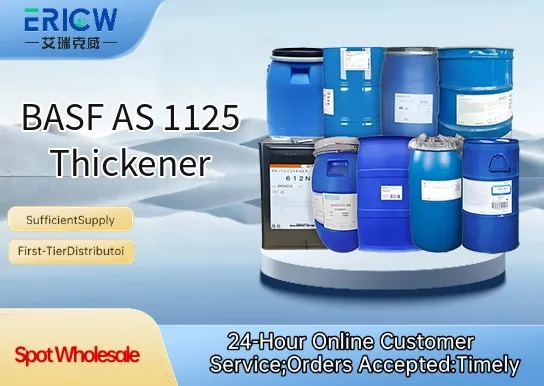
High-efficiency associative thickener delivering excellent rheology control in aqueous systems.
Provides outstanding shear-thinning behavior and sag resistance in vertical applications.
Compatible with a broad range of anionic, nonionic, and cationic surfactants.
Enables low-odor, low-VOC formulations without compromising viscosity performance.
Stable across pH range 4–10, supporting robust formulation flexibility.
Architectural coatings (interior and exterior paints).
Industrial maintenance coatings and protective finishes.
Water-based adhesives and construction sealants.
Tile grouts and cementitious repair mortars.
Textile printing pastes and pigment dispersions.
| Chemical Type | Hydrophobically modified ethoxylated urethane (HEUR) |
| Product Form | Liquid, ready-to-use aqueous dispersion |
| Appearance | Opaque white to off-white liquid |
| pH (1% aqueous solution) | 6.0–7.5 |
| Active Content | 25.0 ± 1.0 wt% |
| Viscosity (Brookfield, 25°C, spindle #3, 20 rpm) | 1,500–3,500 mPa·s |
| Freeze-Thaw Stability | Pass (3 cycles, –15°C to 25°C) |
| Primary Applications | Waterborne coatings, construction chemicals, industrial formulations |
Q1: What type of thickening mechanism does BASF AS 1125 provide?
A: BASF AS 1125 is a hydrophobically modified ethoxylated urethane (HEUR) rheology modifier that functions via associative thickening—forming transient networks between hydrophobic end groups and surfactants or polymer particles in the formulation.
Q2: In which types of water-based systems is BASF AS 1125 typically used?
A: It is widely employed in architectural coatings (e.g., interior and exterior paints), industrial maintenance coatings, and certain waterborne adhesives where balanced flow, sag resistance, and spatter control are required.
Q3: How should BASF AS 1125 be incorporated into a formulation?
A: It is generally added during the let-down stage, after pigments and fillers have been dispersed. Pre-dilution with water or co-solvent is recommended to ensure uniform distribution and avoid localized over-thickening.
Q4: Does BASF AS 1125 require pH adjustment for optimal performance?
A: While it performs well across a broad pH range (typically pH 7–10), stability and thickening efficiency may be enhanced in mildly alkaline conditions. Avoid strongly acidic environments, as they can impair associative network formation.
Q5: Is BASF AS 1125 compatible with common biocides and defoamers used in coatings?
A: Yes, it demonstrates good compatibility with many isothiazolinone- and benzisothiazolinone-based biocides, as well as silicone and mineral oil-based defoamers—though compatibility testing under actual formulation conditions is always advised.
Contact With Us:
E-mail: wangxingqiang@ericwchem.com
Have a Questions? Call Us:
Add:
Building A1, Jiete Industrial Park, Huangpu District, Guangzhou City, Guangdong Province, China