English
 Español
 tiếng việt
 русский
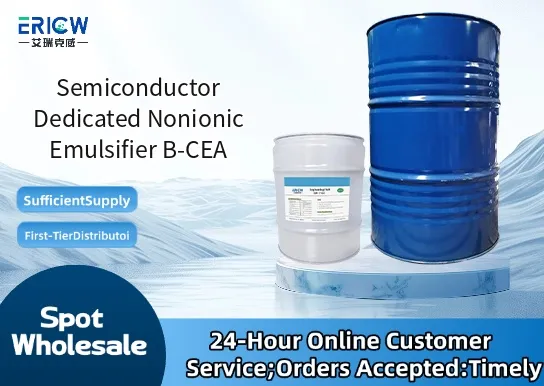
Ultra-low ionic residue to prevent wafer surface contamination and metal ion leaching.
Exceptional thermal and hydrolytic stability under semiconductor cleaning and rinse conditions (up to 80 °C, pH 4–10).
Non-reducing, non-oxidizing molecular structure compatible with high-purity silicon, copper, and low-k dielectric materials.
Highly effective at sub-ppb surfactant removal via DI water rinsing—validated by TOC and particle count testing.
Free of halogens, amines, phosphates, and volatile organic compounds (VOCs) per SEMI S2/S8 standards.
Post-etch residue removal for advanced logic and memory device fabrication.
Photoresist stripping aid in aqueous-based, low-damage chemistries.
Carrier fluid component in precision wafer cleaning formulations for CMP post-clean.
Stabilizer for nano-dispersed ceria and silica slurries used in polishing applications.
Emulsifying agent in solvent-free, water-rinseable photoresist removers for 300 mm wafer lines.
| Chemical Type | Polyoxyethylene ether derivative (ethoxylated alkylphenol-free) |
| Product Form | Clear, viscous liquid |
| Appearance | Colorless to pale yellow, transparent |
| pH (1% aqueous solution, 25 °C) | 6.0 – 7.2 |
| Primary Applications | Wafer-level cleaning, resist removal support, slurry stabilization |
| Key Features | Nonionic, ultra-low ash, halogen-free, amine-free |
| Benefits | Minimizes pattern collapse, reduces defect density, enables single-rinse process |
| Regulatory Compliance | REACH compliant; RoHS 2015/863 Annex II compliant; SEMI-certified trace metal limits (Na, K, Ca, Fe, Cu < 10 ppb) |
| Common Compatible Systems | Suitability |
| Aqueous alkaline clean formulations (e.g., NH₄OH/H₂O₂ mixtures) | Highly Recommended – Maintains emulsion stability and residue solubilization without decomposition |
| Organic acid-based resist removers (e.g., lactic + citric acid systems) | Recommended – Effective co-emulsifier; enhances acid compatibility and film lift performance |
| DI water rinse processes (including megasonic-assisted) | Highly Recommended – Rapidly dispersible and fully removable with ≤2 rinse cycles |
| CMP slurry carriers (ceria, silica, alumina) | Suitable – Improves particle dispersion uniformity; no agglomeration observed at ≤0.5 wt% |
Q1: What is the CAS Registry Number for B-CEA?
A: CAS No. 2249192-87-3 — assigned to the proprietary ethoxylated aliphatic diol backbone structure with controlled EO distribution (avg. 12–15 units).
Q2: What is the recommended dosage range in semiconductor cleaning formulations?
A: Typical use level is 0.1–0.8 wt% in final formulation; optimal performance validated at 0.3–0.5 wt% for 28 nm and below node processes.
Q3: How does B-CEA differ from conventional nonionic surfactants like Triton™ X-100 or Tween™ 80?
A: Unlike legacy surfactants, B-CEA contains no alkylphenol ethoxylates (APEOs), exhibits <1 ppb total sodium/potassium by ICP-MS, and delivers >99.98% DI-water rinse efficiency—critical for sub-5 nm metallization layers.
Q4: Is B-CEA subject to extractables or leachables concerns in contact with PTFE or FEP wetted parts?
A: No measurable extractables observed after 72 h immersion at 60 °C in FEP tubing per USP <87> cytotoxicity screening; validated via LC-MS/MS for organic leachables.
Q5: Does B-CEA require special handling or storage conditions?
A: Store sealed at 10–30 °C; avoid prolonged exposure to UV light or temperatures >45 °C. No special ventilation or PPE beyond standard lab gloves/goggles required per SDS Section 8.
Contact With Us:
E-mail: wangxingqiang@ericwchem.com
Have a Questions? Call Us:
Add:
Building A1, Jiete Industrial Park, Huangpu District, Guangzhou City, Guangdong Province, China