English
 Español
 tiếng việt
 русский
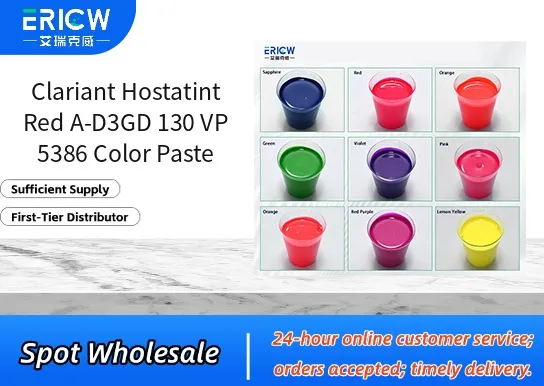
High chroma red shade with excellent lightfastness and thermal stability up to 220 °C.
Optimized for dispersion in polyolefin (PP, PE) and engineering thermoplastics including ABS and PS.
Low migration and bleed resistance compliant with EU Directive 2002/72/EC for food-contact plastics.
Free of heavy metals, azo dyes, and REACH-regulated SVHC substances.
Ready-to-use liquid color paste with consistent rheology and long-term storage stability.
Packaging films and containers for food, pharmaceuticals, and consumer goods.
Automotive interior components including dashboards, trim parts, and air vents.
Household appliances housings and decorative panels requiring vibrant, durable coloration.
Technical injection-molded parts in electronics and medical devices.
Blown and cast polyolefin films requiring high clarity and color uniformity.
| Chemical Type | Organic pigment dispersion (quinacridone-based) |
| Product Form | Liquid color paste |
| Appearance | Viscous red paste, homogeneous without sedimentation |
| Primary Applications | Polyolefins (PP, HDPE, LDPE), ABS, PS, and TPE compounds |
| Key Features | Excellent dispersibility, low dusting, high tinctorial strength |
| Benefits | Reduced processing time, improved color consistency, lower dosing requirement |
| Storage Conditions | Store at 15–25 °C; protect from freezing and direct sunlight |
| Shelf Life | 24 months from date of manufacture under recommended conditions |
Q1: What is the primary application field for Hostatint Red A-D3GD 130 VP 5386?
A: This pigment paste is specifically formulated for coloring polyolefin-based compounds, including PP and HDPE, commonly used in injection molding, blow molding, and extrusion applications—especially where high thermal stability and dispersion performance are required.
Q2: Is this product suitable for food-contact applications?
A: Hostatint Red A-D3GD 130 VP 5386 is designed to meet general regulatory expectations for pigments used in polyolefins intended for food-contact articles, subject to final formulation compliance and applicable regional requirements. Users must validate suitability within their specific end-use and processing conditions.
Q3: How should this color paste be incorporated into polymer melts?
A: It is typically introduced via masterbatch dilution or direct gravimetric feeding during compounding. Good melt mixing and sufficient residence time are recommended to ensure uniform dispersion and optimal color development.
Q4: Does this paste contain heavy metals or halogenated compounds?
A: Hostatint Red A-D3GD 130 VP 5386 is manufactured without intentionally added heavy metals (e.g., lead, cadmium, mercury, hexavalent chromium) or halogenated carriers, aligning with Clariant’s commitment to sustainable and restricted-substance-free solutions.
Q5: What is the typical dosage range when using this paste in polypropylene?
A: Dosage depends on the desired shade intensity and base polymer properties, but it is generally used at low concentrations—typically ranging from 0.1% to 2% by weight relative to the final compound.
Contact With Us:
E-mail: wangxingqiang@ericwchem.com
Have a Questions? Call Us:
Add:
Building A1, Jiete Industrial Park, Huangpu District, Guangzhou City, Guangdong Province, China