English
 Español
 tiếng việt
 русский
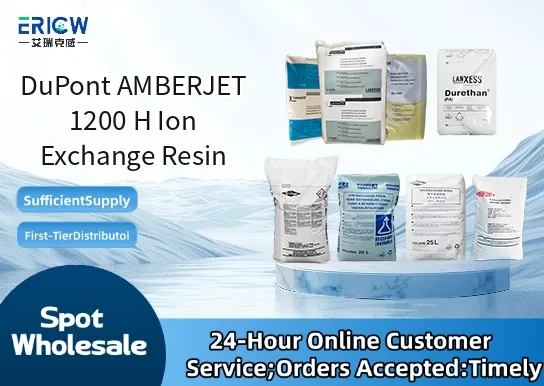
High-capacity, gel-type strong acid cation exchange resin in hydrogen form.
Optimized for high-efficiency demineralization and softening in industrial water treatment systems.
Excellent physical and chemical stability with low attrition loss during hydraulic cycling.
Consistent spherical bead morphology ensures uniform flow distribution and low pressure drop.
Manufactured to stringent DuPont quality standards with full traceability and batch documentation.
Primary cation exchange unit in mixed-bed and dual-bed deionization systems.
Feedwater pretreatment for high-purity steam generation in power plants.
Pharmaceutical-grade purified water (PW) and water-for-injection (WFI) production.
Electronics manufacturing ultrapure water (UPW) polishing and polishing loop service.
Food and beverage process water conditioning requiring low sodium and heavy metal leaching.
| Chemical Type | Strong acid cation (sulfonic acid) |
| Product Form | Hydrogen (H⁺) form |
| Appearance | Amber, spherical beads |
| Functional Group | –SO₃H |
| Moisture Content | 45–50% (as shipped) |
| Particle Size Range | 0.3–1.2 mm |
| Uniformity Coefficient | ≤1.6 |
| Maximum Operating Temperature | 120 °C (248 °F) |
Q1: What is the primary function of AMBERJET 1200 H in water treatment systems?
A: AMBERJET 1200 H is a strong acid cation exchange resin in hydrogen form, designed primarily for demineralization and softening applications—removing hardness ions (e.g., Ca²⁺, Mg²⁺) and other dissolved cations from process or feed water to produce high-purity water.
Q2: Can AMBERJET 1200 H be used in mixed-bed configurations?
A: Yes—it is commonly deployed in mixed-bed polishing units alongside strong base anion resins to achieve ultrapure water quality, especially in power generation, pharmaceutical, and microelectronics applications where low conductivity and minimal ionic contamination are critical.
Q3: How is AMBERJET 1200 H regenerated after exhaustion?
A: The resin is regenerated using a dilute solution of mineral acid—typically hydrochloric acid (HCl) or sulfuric acid (H₂SO₄)—which restores its hydrogen-form functionality by displacing accumulated cations from the exchange sites.
Q4: Is AMBERJET 1200 H suitable for high-flow or high-temperature service?
A: It is engineered for reliable performance under standard industrial operating conditions, including continuous service at temperatures up to approximately 120 °C. Its uniform bead structure and high crosslinking support stable hydraulics and resistance to osmotic shock in demanding flow regimes.
Q5: What distinguishes AMBERJET 1200 H from gel-type cation resins?
A: As a macroporous resin, AMBERJET 1200 H offers enhanced physical stability, superior resistance to fouling by organic matter or iron, and more consistent kinetics in waters with variable composition—making it especially robust for challenging feedwater sources compared to conventional gel-type alternatives.
Contact With Us:
E-mail: wangxingqiang@ericwchem.com
Have a Questions? Call Us:
Add:
Building A1, Jiete Industrial Park, Huangpu District, Guangzhou City, Guangdong Province, China