English
 Español
 tiếng việt
 русский
High thermal stability up to 800°C, suitable for high-temperature processing applications.
Excellent lightfastness and weather resistance, maintaining color integrity under prolonged UV exposure.
Non-toxic and heavy-metal-free formulation, compliant with global regulatory standards including EN 71-3 and RoHS.
Superior dispersion performance in aqueous and solvent-based systems, enabling uniform color development.
Chemically inert and alkali-resistant, ensuring compatibility with cementitious and lime-based matrices.
Architectural concrete and precast concrete products.
Ceramic glazes and frits for wall and floor tiles.
Exterior stucco, render, and mineral plasters.
Colored roofing granules and asphalt coatings.
Inorganic pigment dispersions for industrial coatings and fire-resistant paints.
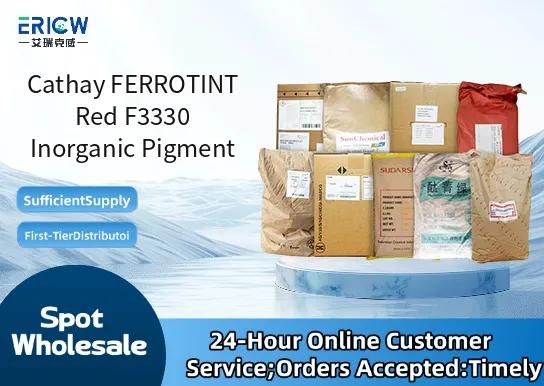
| Chemical Type | Iron oxide-based inorganic pigment (α-Fe₂O₃) |
| Product Form | Free-flowing dry powder |
| Appearance | Reddish-brown fine powder |
| Primary Applications | Concrete, ceramics, construction materials, coatings |
| Key Features | Heat stable, lightfast, non-toxic, alkali resistant |
| Particle Size (D50) | 0.8–1.2 μm |
| Bulk Density | 0.9–1.1 g/cm³ |
| VOC Content | Not applicable (solvent-free solid) |
Q1: What is the primary chemical composition of Cathay FERROTINT Red F3330?
A: Cathay FERROTINT Red F3330 is an iron oxide-based inorganic pigment, primarily composed of hematite (α-Fe₂O₃), engineered for high chroma, thermal stability, and consistent particle morphology.
Q2: Is this pigment suitable for use in polyolefin plastics such as PP and PE?
A: Yes — F3330 is specifically formulated for excellent dispersion and thermal stability in polyolefin systems, including injection-molded and extruded applications up to typical processing temperatures of 240–280°C.
Q3: How does F3330 compare to organic red pigments in terms of lightfastness and weather resistance?
A: As an inorganic iron oxide pigment, F3330 offers superior lightfastness, UV stability, and long-term outdoor durability compared to most organic reds — making it preferred for exterior applications where color retention under prolonged exposure is critical.
Q4: Can F3330 be used in water-based coatings without significant flocculation or viscosity issues?
A: Yes — when properly dispersed using conventional surfactants or dispersing agents, F3330 demonstrates good compatibility and rheological stability in aqueous architectural and industrial coating systems.
Contact With Us:
E-mail: wangxingqiang@ericwchem.com
Have a Questions? Call Us:
Add:
Building A1, Jiete Industrial Park, Huangpu District, Guangzhou City, Guangdong Province, China