English
 Español
 tiếng việt
 русский
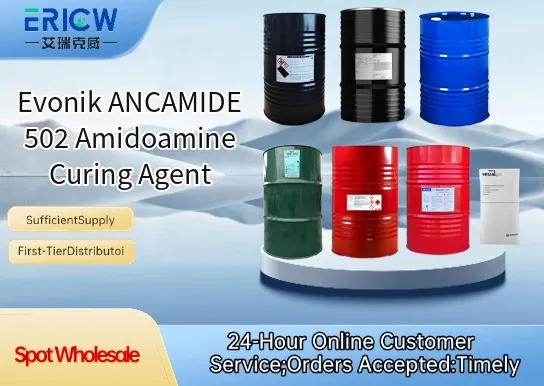
Low-viscosity liquid enabling easy handling and efficient mixing with epoxy resins.
Offers balanced reactivity—faster cure than conventional polyamide amines without excessive exotherm.
Delivers excellent adhesion to metals, concrete, and composites in demanding structural applications.
Provides superior flexibility and impact resistance in cured epoxy systems.
Compatible with standard bisphenol-A and bisphenol-F epoxy resins across broad formulation ranges.
Structural adhesives for automotive and aerospace bonding.
High-performance epoxy grouts and mortars for industrial flooring and concrete repair.
Electrical encapsulation and potting compounds requiring thermal stability and dielectric integrity.
Composite matrix resins for wind blade bonding and marine laminates.
Coating systems for corrosion protection of steel infrastructure and offshore assets.
| Chemical Type | Amidoamine (derived from dimer fatty acid and polyethyleneamine) |
| Product Form | Liquid |
| Appearance | Amber to light brown, clear to slightly hazy liquid |
| Amine Value (mg KOH/g) | 340–380 |
| Viscosity at 25 °C (mPa·s) | 800–1,200 |
| Reactive Hydrogen Equivalent Weight (g/eq) | 175–195 |
| Density at 25 °C (g/cm³) | 0.94–0.97 |
| Primary Applications | Epoxy adhesive, coating, and composite curing agent |
Q1: What is the primary function of ANCAMIDE 502 in epoxy systems?
A: ANCAMIDE 502 acts as a reactive amidoamine curing agent, enabling ambient- or low-temperature cure of epoxy resins while delivering good flexibility, adhesion, and chemical resistance in the final network.
Q2: Is ANCAMIDE 502 suitable for moisture-sensitive applications?
A: Yes — as an amidoamine, it exhibits lower sensitivity to ambient moisture compared to conventional aliphatic amines, supporting more robust processing in moderate humidity conditions without significant loss of pot life or cure performance.
Q3: How does ANCAMIDE 502 compare to traditional polyamide curing agents in terms of flexibility and toughness?
A: ANCAMIDE 502 typically delivers enhanced toughness and impact resistance relative to standard polyamides, owing to its tailored molecular architecture — resulting in cured films with improved elongation and reduced brittleness, especially in coatings and adhesive formulations.
Q4: Can ANCAMIDE 502 be used in food-contact or industrial maintenance coatings?
A: It is commonly selected for industrial maintenance, protective coatings, and certain non-food-contact adhesive applications. For regulated end-uses such as food contact, formulation compliance must be verified case-by-case through full system testing and regulatory review — Evonik does not pre-approve specific finished-article applications.
Q5: What guidance is available for optimizing pot life and cure speed with ANCAMIDE 502?
A: Pot life and cure profile can be adjusted by varying the mixing ratio with epoxy resin, incorporating co-catalysts (e.g., tertiary amines), or blending with other curing agents — typical use levels range from 0.1% to 2% by weight relative to resin solids, depending on desired performance balance.
Contact With Us:
E-mail: wangxingqiang@ericwchem.com
Have a Questions? Call Us:
Add:
Building A1, Jiete Industrial Park, Huangpu District, Guangzhou City, Guangdong Province, China