English
 Español
 tiếng việt
 русский
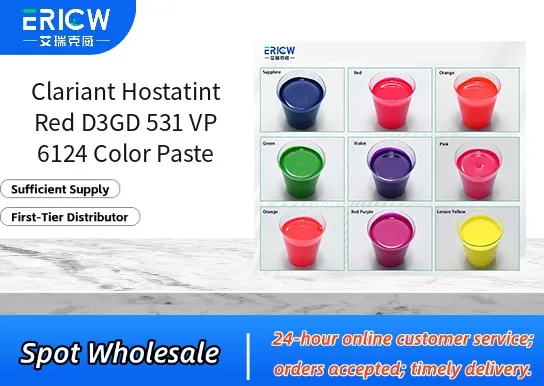
High chroma red shade with excellent color strength and batch-to-batch consistency.
Optimized for dispersion in water-based systems, offering low viscosity and easy incorporation.
Good lightfastness and thermal stability suitable for processing up to 180 °C.
Compliant with major global regulatory frameworks including EU REACH and US FDA 21 CFR for applicable applications.
Free of APEOs, heavy metals, and CMRs (carcinogenic, mutagenic, reprotoxic substances).
Water-based architectural coatings and interior wall paints.
Industrial maintenance coatings for metal and concrete substrates.
Wood stains and clear finishes requiring transparent red tinting.
Printing inks for packaging applications on porous substrates.
Plastic masterbatches for polyolefins and PVC where heat stability is critical.
| Chemical Type | Azo pigment dispersion |
| Product Form | Concentrated aqueous color paste |
| Appearance | Homogeneous red liquid, free of sediment and visible particles |
| Primary Applications | Water-based coatings, inks, and plastic coloration |
| Key Features | High tinctorial strength, low VOC, non-settling formulation |
| Benefits | Reduced dosing, improved storage stability, simplified handling |
| pH (25 °C) | 7.5–8.5 |
| Storage Stability | ≥12 months at 5–30 °C in sealed original container |
Q1: What types of polymer systems is Hostatint Red D3GD 531 VP 6124 compatible with?
A: This color paste is specifically formulated for use in polyolefins—including PP and HDPE—as well as engineering thermoplastics such as ABS, PS, and certain polyamides. It demonstrates good thermal stability during standard melt processing conditions.
Q2: How should this color paste be incorporated into a polymer formulation?
A: Hostatint Red D3GD 531 VP 6124 is typically added directly to the base polymer via gravimetric or volumetric dosing systems prior to extrusion or injection molding. It is designed for efficient dispersion without requiring pre-dilution or masterbatch dilution steps.
Q3: Is this product suitable for applications requiring regulatory compliance for food contact or toys?
A: Hostatint Red D3GD 531 VP 6124 is developed for industrial and general-purpose coloring applications. For regulated end uses—such as food-contact plastics or toys—formulators must verify suitability through full regulatory assessment, including migration testing and compliance with applicable regional requirements.
Q4: What is the recommended dosage range for achieving consistent red shades?
A: Dosage depends on the desired shade intensity and base polymer characteristics, but typical usage generally ranges from 0.1% to 2% by weight. Optimal loading should be determined empirically during formulation development to ensure uniform dispersion and color stability.
Contact With Us:
E-mail: wangxingqiang@ericwchem.com
Have a Questions? Call Us:
Add:
Building A1, Jiete Industrial Park, Huangpu District, Guangzhou City, Guangdong Province, China