English
 Español
 tiếng việt
 русский
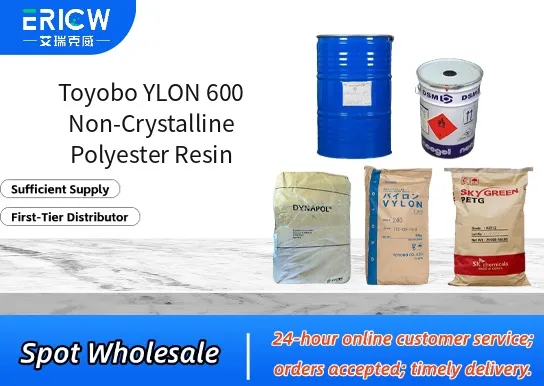
Amorphous molecular structure enabling excellent optical clarity and transparency.
Superior thermal stability with glass transition temperature (Tg) of approximately 75–80°C.
High solubility in common organic solvents including ethyl acetate, toluene, and MEK.
Low viscosity at processing temperatures, facilitating easy coating, impregnation, and film formation.
Excellent compatibility with cellulose acetate butyrate (CAB), acrylics, and nitrocellulose-based systems.
High-gloss protective topcoats for automotive trim and interior plastic parts.
Clear overprint varnishes for flexible packaging and label laminates.
Base resin in specialty ink formulations for gravure and flexographic printing.
Adhesion promoter and binder in transparent decorative films and transfer foils.
Component in UV-curable hybrid systems requiring non-crystalline polyester backbone.
| Chemical Type | Non-crystalline aromatic-aliphatic polyester |
| Product Form | Pellets or flake solid |
| Appearance | Off-white to light yellow translucent solid |
| Glass Transition Temperature (Tg) | 75–80°C (DSC, 10°C/min) |
| Softening Point | Approx. 85–90°C (ring-and-ball method) |
| Solubility | Freely soluble in esters, ketones, and aromatic hydrocarbons |
| Key Features | Non-crystalline, thermoplastic, solvent-soluble, low melt viscosity |
| Primary Applications | Coatings, inks, laminating adhesives, and functional films |
Q1: What distinguishes YLON 600 from crystalline polyester resins in food-contact applications?
A: Unlike crystalline polyesters, YLON 600 is non-crystalline, offering superior clarity, uniform film formation, and enhanced compatibility with amorphous polymer matrices—making it particularly suitable for transparent food packaging layers where optical consistency and process stability are critical.
Q2: Is YLON 600 compatible with common barrier polymers such as EVOH or PVDC?
A: Yes, YLON 600 demonstrates good interfacial adhesion and thermal stability when co-extruded or laminated with standard barrier resins like EVOH and PVDC, supporting robust multilayer structures without delamination under typical processing conditions.
Q3: How does YLON 600 perform under high-humidity storage conditions?
A: As a non-crystalline polyester resin, YLON 600 exhibits low moisture sensitivity compared to many crystalline alternatives, maintaining dimensional stability and mechanical integrity in humid environments—ideal for packaging applications exposed to ambient or refrigerated high-moisture conditions.
Q4: Can YLON 600 be used in heat-sealable layers?
A: While not inherently heat-sealable on its own, YLON 600 is frequently formulated into heat-seal layers by blending with compatible low-melting co-polymers or functionalized ethylene-based resins—enabling tunable seal initiation temperatures and hot-tack performance in final laminates.
Contact With Us:
E-mail: wangxingqiang@ericwchem.com
Have a Questions? Call Us:
Add:
Building A1, Jiete Industrial Park, Huangpu District, Guangzhou City, Guangdong Province, China