English
 Español
 tiếng việt
 русский
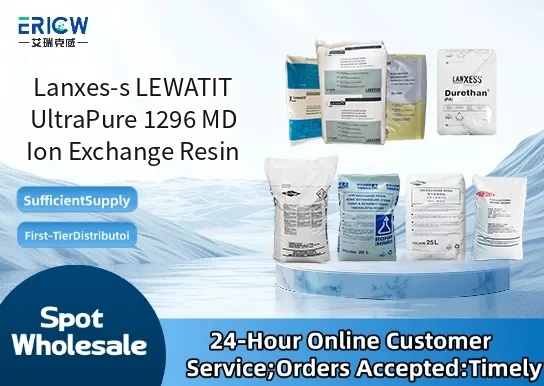
Ultra-low extractables profile specifically engineered for ultra-high-purity water production in pharmaceutical and biotech manufacturing.
Highly uniform spherical beads with narrow particle size distribution (PSD) ensuring low pressure drop and optimal hydraulic performance.
Exceptional chemical and osmotic stability, validated for repeated regeneration cycles with strong acid and alkali solutions.
Low total organic carbon (TOC) leachables—certified to meet USP <841> and EP 2.2.43 requirements for purified water systems.
Pre-packed and pre-conditioned format minimizes commissioning time and reduces risk of operator handling errors.
Final polishing stage in pharmaceutical-grade purified water (PW) and water for injection (WFI) generation systems.
Ultrapure water production for biopharmaceutical upstream and downstream processing utilities.
Critical deionization in clean steam condensate polishing loops requiring minimal ion leakage.
Regulatory-compliant water treatment for API synthesis and sterile manufacturing support utilities.
| Chemical Type | Strong Acid Cation (SAC) Exchange Resin — Sulfonated polystyrene-divinylbenzene matrix |
| Product Form | Pre-packed, pre-conditioned, ready-to-use cartridge or column format |
| Appearance | Uniform amber, spherical beads |
| Primary Applications | Pharmaceutical purified water (PW), water for injection (WFI), and biotech ultrapure water systems |
| Key Features | Ultra-low TOC leachables, narrow PSD, high regeneration efficiency, USP/EP compliant |
| Storage Conditions | 5–35 °C; protect from freezing and direct sunlight |
| Maximum Operating Temperature | 50 °C (continuous), 60 °C (short-term) |
| Regenerant Compatibility | NaCl, HCl, and NaOH — validated for multi-cycle use per regulatory guidelines |
Q1: What is the primary application of Lanxes-s LEWATIT UltraPure 1296 MD?
A: This resin is specifically engineered for high-purity water polishing in critical applications such as pharmaceutical-grade water systems, biopharmaceutical process streams, and ultrapure water loops where low leachables, minimal organic extractables, and consistent ion removal performance are essential.
Q2: How does Lanxes-s LEWATIT UltraPure 1296 MD differ from standard Lewatit S 1296 resins?
A: UltraPure 1296 MD undergoes an additional proprietary purification and conditioning process to significantly reduce residual monomers, oligomers, and ionic impurities—resulting in lower conductivity spikes, reduced TOC release, and enhanced compatibility with stringent regulatory expectations for sensitive life science applications.
Q3: Is this resin suitable for use in steam sanitization cycles?
A: Yes—Lanxes-s LEWATIT UltraPure 1296 MD is designed for thermal stability under repeated hot water and steam sanitization conditions typical in pharmaceutical water systems, maintaining structural integrity and exchange capacity without significant degradation or particle shedding.
Q4: What regeneration protocol is recommended?
A: Standard sodium chloride regeneration is effective; however, due to its ultra-pure grade formulation, optimized regenerant concentration and flow rates should be determined based on system design, feedwater quality, and required effluent specifications—typically using lower NaCl concentrations than conventional resins to minimize rinse volume and residual chloride.
Q5: Can it be used in mixed-bed configurations with other ultra-pure resins?
A: Yes—it is fully compatible with high-quality, similarly purified strong base anion resins in mixed-bed systems, and is often selected for its balanced kinetic performance and low pressure drop characteristics, supporting stable operation in continuous deionization loops.
Contact With Us:
E-mail: wangxingqiang@ericwchem.com
Have a Questions? Call Us:
Add:
Building A1, Jiete Industrial Park, Huangpu District, Guangzhou City, Guangdong Province, China